Introduction
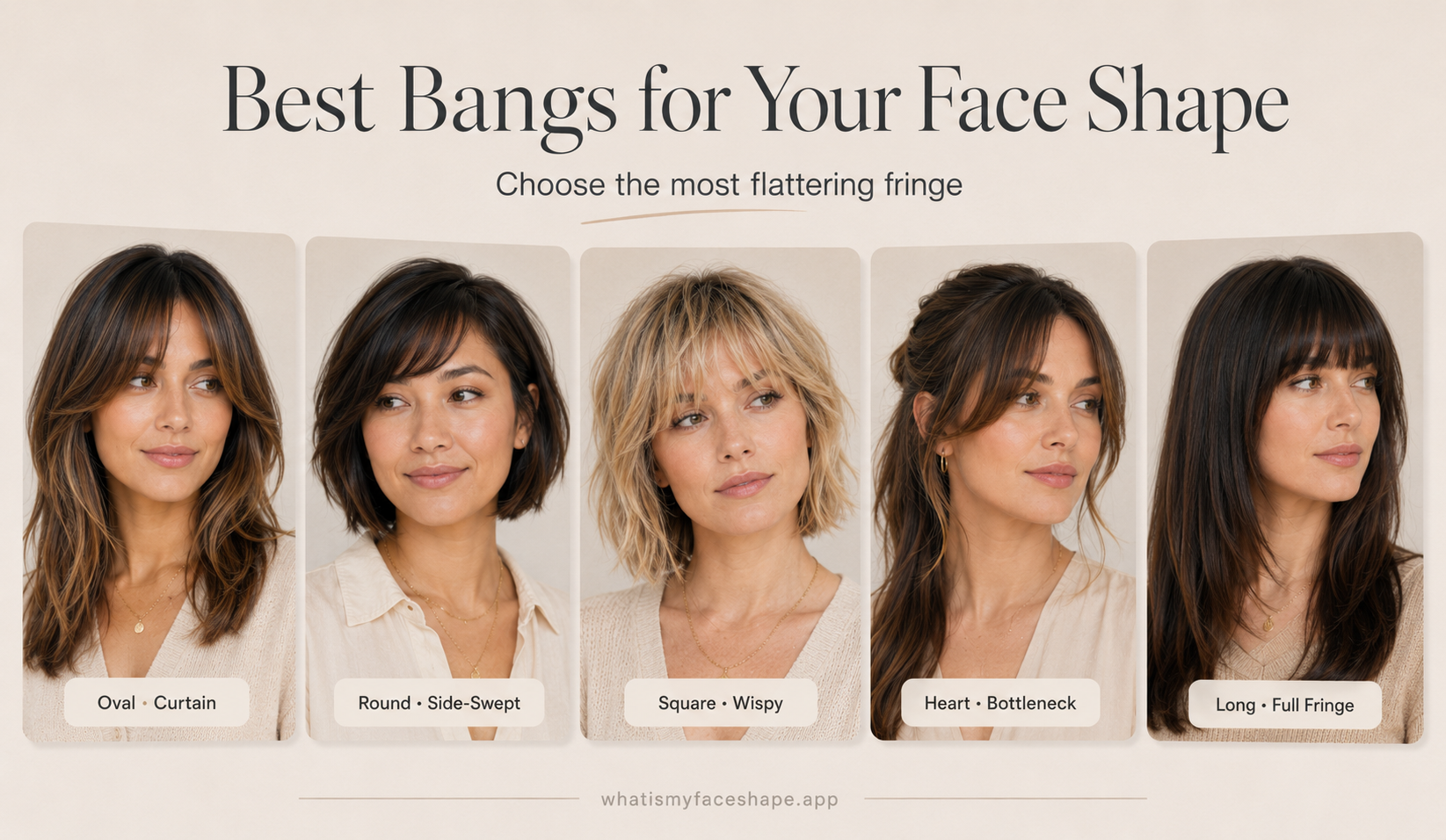
The best bangs for your face shape are the ones that fix the visual math: round faces usually win with long curtain or side-swept pieces, square faces look better with soft texture and movement, heart faces balance out with wispy or curtain fringe that pulls attention down, oval faces can wear basically anything, and long faces often benefit from fuller, straighter bangs that “cut” the length.
That’s the whole game. Balance. Not trends.
And yes, bangs are a commitment — but not the kind people dramatize. They’re a framing tool, not a life sentence. You’re not “marrying” a fringe; you’re choosing where the eye lands around your forehead, eyes, cheekbones, and jawline.
That’s why the same bangs can look soft and balanced on one face shape, but heavy or awkward on another. Before you cut, check your face shape with whatismyfaceshape.app so you can choose a fringe that works with your proportions, not against them. So let’s pick the right bang style on purpose, with your bone structure, your hair type, and your actual morning routine in the room.
How do you identify your face shape fast?
Mirror test
Pull your hair back so your natural hairline is visible. Not slicked so tight you look like a different person, just out of the way. Stand in front of a mirror, shoulders relaxed, and look at three zones: forehead width, cheek width, and jawline.
If your cheekbones are the widest and your jaw tapers, you’re drifting heart. If forehead, cheekbones, and jaw are pretty balanced with soft edges, you’re probably oval. If your jaw is strong and your sides look straight, you’re in square territory. If your cheeks are the headline and everything reads soft and circular, that’s the round family. If everything feels stretched vertically, you’re in long face shapes.
Don’t overthink the category. Your face is not a BuzzFeed quiz. You’re trying to find your dominant shape so you can stop guessing about fringe.
Photo check
Use your phone camera at eye level, not from below — that angle changes your proportions instantly. Take one straight-on photo, then one three-quarter angle. The second one often tells you more, because it shows how your bangs will frame your face in real life: at work, at dinner, on dates, and in photos you do not retake ten times.
Look at the basics: does your face appear longer than it is wide, softly rounded, angular at the jaw, wider at the forehead, or fuller through the cheeks? Those small proportion cues matter when choosing bangs.
If you do not want to guess, upload or check your face shape at whatismyfaceshape.app before booking the cut. It gives you a clearer starting point, so you can compare your result with the bang styles in this guide and choose a fringe that works with your actual proportions.
Common mistakes
People mess this up in predictable ways, and it’s usually because they’re judging the wrong “edge.”
- They judge their cheeks based on fullness instead of bone structure, which is how you end up calling a square face “round” just because it’s youthful.
- They ignore asymmetry, even though mild asymmetry is normal and common, and it can change how a fringe sits on the forehead (this Frontiers in Psychology study on facial asymmetry and attractiveness perception is a good reminder that “perfect symmetry” is not the point).
- They classify themselves by one feature, like “I have a big forehead,” then pick a bang shape that fights everything else.
You’re not choosing bangs for your forehead alone. You’re choosing them for the whole head and the way your features read together.
What matters more than face shape?
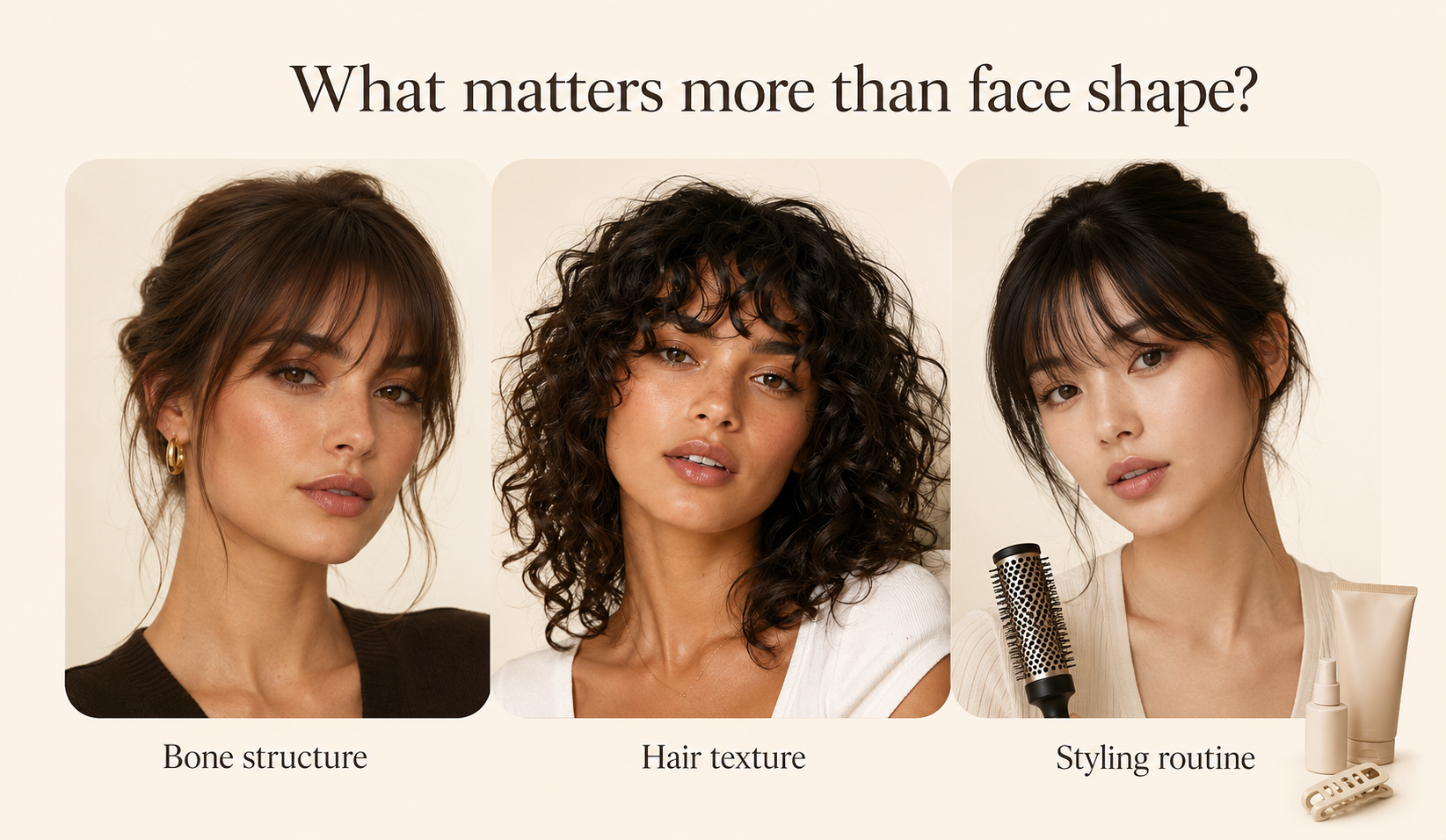
Bone structure
Stylists talk about bone structure because it’s the scaffolding. Cheekbone height. Jaw angle. Chin length. Those don’t change when your weight fluctuates, when you’re puffy from a flight, when the lighting is bad.
I’m a little ruthless about this: if your jawline is sharp, you need softness somewhere else unless you’re intentionally going for a graphic, severe look. If your mid-face is full, you need vertical lines and negative space so your cheeks don’t dominate every image. That’s why the “same” bangs can look editorial on one person and costume-y on another.
Hair texture
Your hair texture decides whether your fringe behaves or rebels.
Fine straight hair can do blunt bangs beautifully, but it also shows every greasy day and every cowlick. Wavy hair makes curtain bangs look expensive with almost no effort, but it can shrink the length if you cut too short. Coily and tightly textured hair can wear bangs too, obviously, but shrinkage and density mean your “right bang length” on day one might jump an inch on day two.
This is why I roll my eyes when people ask for “the best bang styles” without talking about hair types. It’s like ordering shoes without mentioning the size.
Styling routine
Be honest. Are you a blow-dry person? A wash-and-go person? Do you actually use a round brush, or do you own one and it lives under the sink like a haunted artifact?
Bangs require micro-styling. Not a full glam session. Just consistent, small effort. If you’re not willing to do that, pick a longer bang style that can blend into the rest of your haircut and survive a lazy morning.
Use this quick guide to pick a style
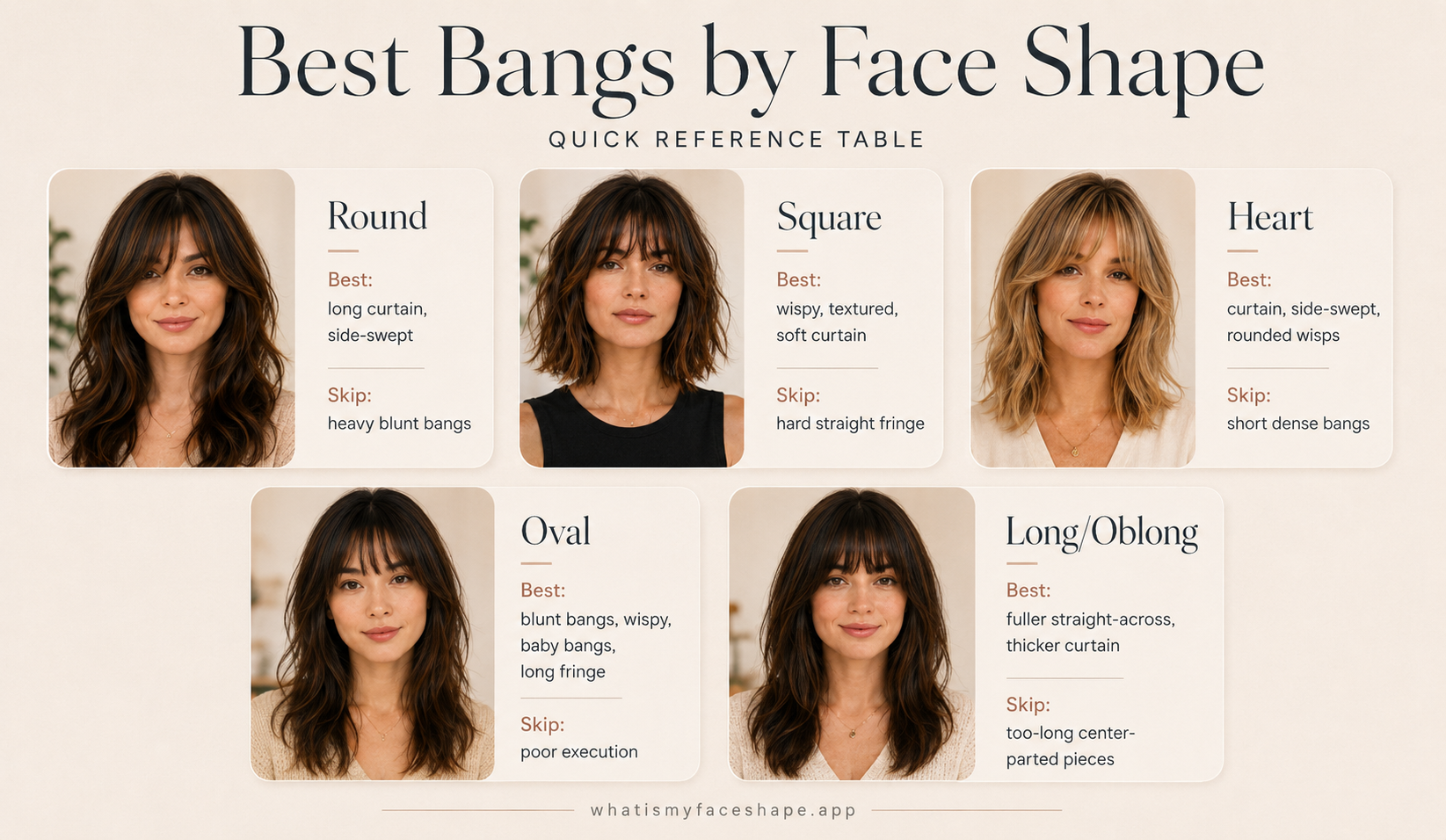
Face-shape table
Use this as a quick reference, then adjust for your personal style and hair type. I’m not trying to turn you into a diagram.
| Face shape | Best bang styles | What usually looks off |
|---|---|---|
| Round | Long curtain, side-swept, cheekbone-skimming fringe | Heavy blunt bangs that widen the mid-face |
| Square | Wispy, layered, textured, soft curtain | Hard straight fringe that emphasizes angles |
| Heart | Curtain, side-swept, rounded wisps | Short dense bangs that spotlight the forehead |
| Oval | Blunt bangs, wispy, baby bangs, long fringe | Mostly “nothing,” just bad execution |
| Long/Oblong | Fuller straight-across, thicker curtain with weight | Too-long center-parted pieces that elongate more |
This lines up with the mainstream pro advice too. Glamour’s stylists tend to steer round faces toward elongating fringe, not heavy blunt cuts (their round-face guidance is pretty consistent with real salon outcomes), and Vogue regularly pushes texture for square shapes because movement softens edges (their face-shape bang guide is basically that idea, polished).
Length cheat sheet
Length is where people accidentally sabotage themselves. A half-inch changes everything.
| Bang length target | Where it hits | What it does to your look |
|---|---|---|
| Brow-grazing | At or just above eyebrows | Strong frame, more “fashion,” more trim upkeep |
| Eye-skimming | Around lash line when relaxed | Sultry, heavier, can annoy you daily |
| Cheekbone-skimming | Near top of cheekbone | Best for slimming and sculpting in photos |
| Lip-length (curtain) | Around mouth corners | Easy grow-out, blends into layers fast |
Safest starter options
If you’re unsure, start with curtain or long side-swept bangs. That’s my practical, everyday pick. You can pin them back, you can blend them, you can grow them without wanting to shave your head in month three.
And yes, you can cheat first. Clip-ins. A soft trial. Wear them around your home for a few days, take images in different lighting, see how your face reads on Zoom (brutal, but useful).
Which bangs suit a round face best?
Best picks
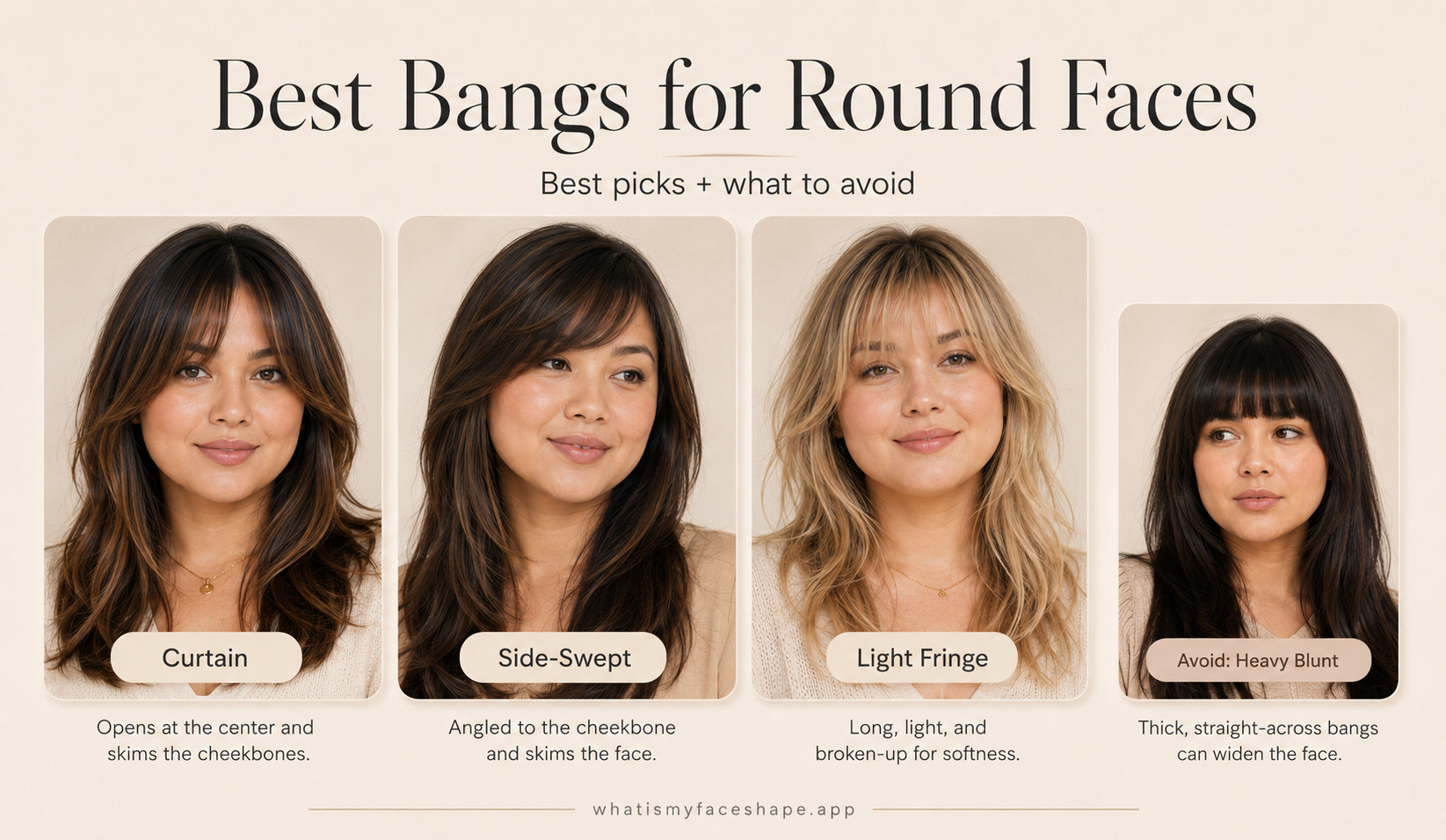
I’m Team Curtain or Side-Swept for a round face. Long curtain pieces that open around the center and skim the cheekbone create vertical lines. Your face reads longer. Your features look sharper. Your selfies stop looking like a cute cookie cutter.
If you’re photographed from the side or three-quarters a lot, ask for long bangs angled to hit the cheekbone area, not the apple of the cheek. That little shift matters.
Avoid list
A thick, straight-across fringe can make the widest part of the cheeks look even wider. If you love blunt bangs as a concept, keep them longer and slightly broken-up so there’s airflow and softness.
Also, don’t let a stylist “over-densify” the fringe by pulling hair too far back from the part. That’s how you get helmet-bang. Nobody asked for that.
Curtain bang notes
Curtain bangs for face shape questions usually ignore density, so I’ll say it plainly: a round face does better when curtain pieces are longer and lighter, not short and puffy. Think vertical drape, not little parentheses sitting on your forehead.
Which bangs suit a square face best?
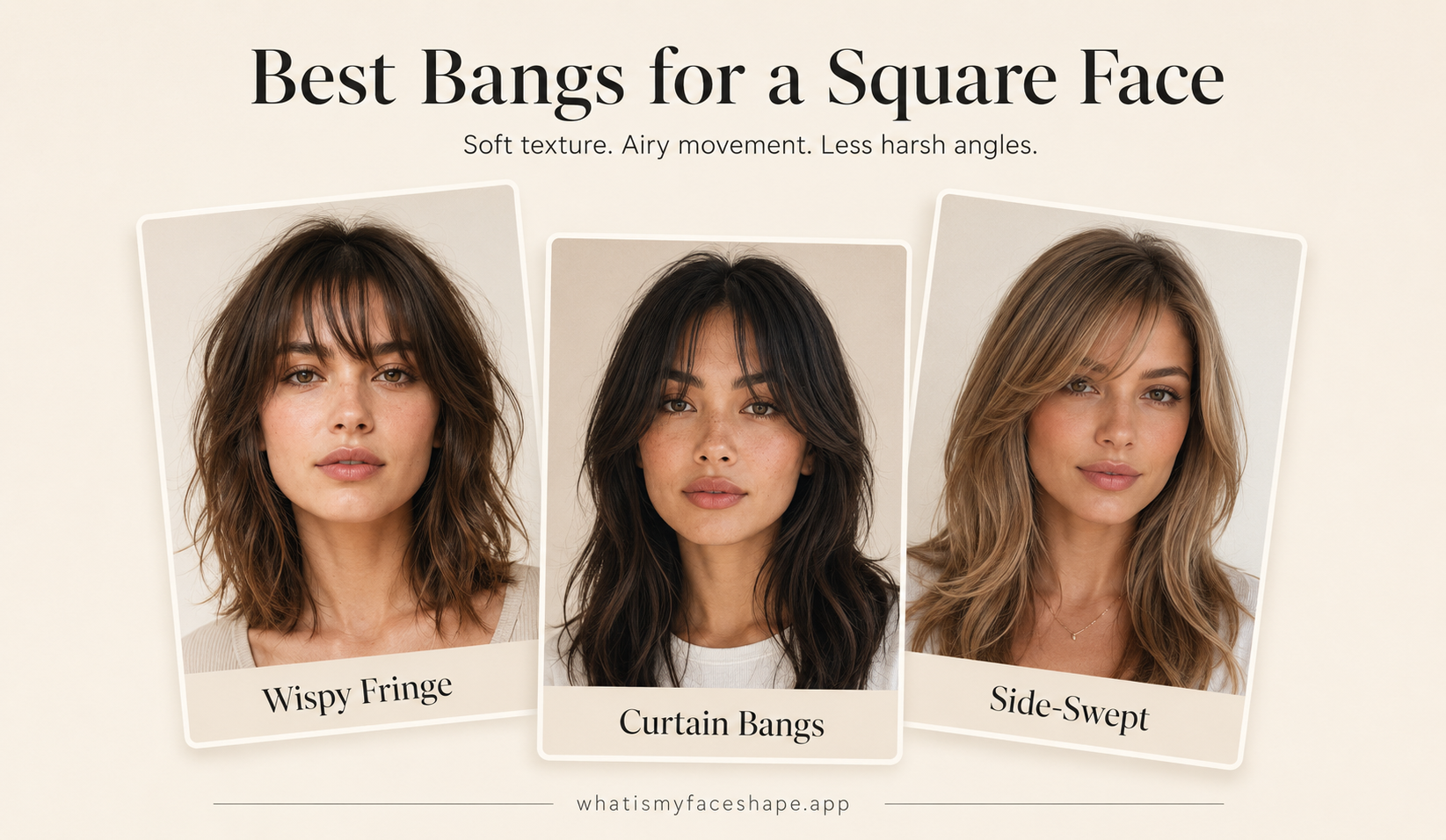
Best picks
Square faces look incredible with texture. Wispy, choppy, layered fringe, anything that breaks up a strong line. If your jaw is a clean angle, you don’t need a hard bang edge fighting it.
Curtain bangs are popular here because they echo cheekbone structure while softening the corners, and that’s the real point. Movement. Air.
Avoid list
Hard, straight fringe with a blunt baseline can box in the face. If you want a more graphic look, keep the edges rounded and the interior slightly textured so it doesn’t look like it was cut with a ruler in a rush.
Curtain bang notes
For square shapes, ask for curtain pieces that start a little higher, then sweep. If they start too low and too thick, the fringe can just sit there, heavy, and your forehead looks shorter than it is.
And eyebrows matter more than people admit. Brow shape is part of the upper-frame architecture, and Vogue’s brow mapping rundown is actually useful if you want your fringe and brow to stop competing (their eyebrow mapping guide is solid).
Which bangs suit a heart face best?
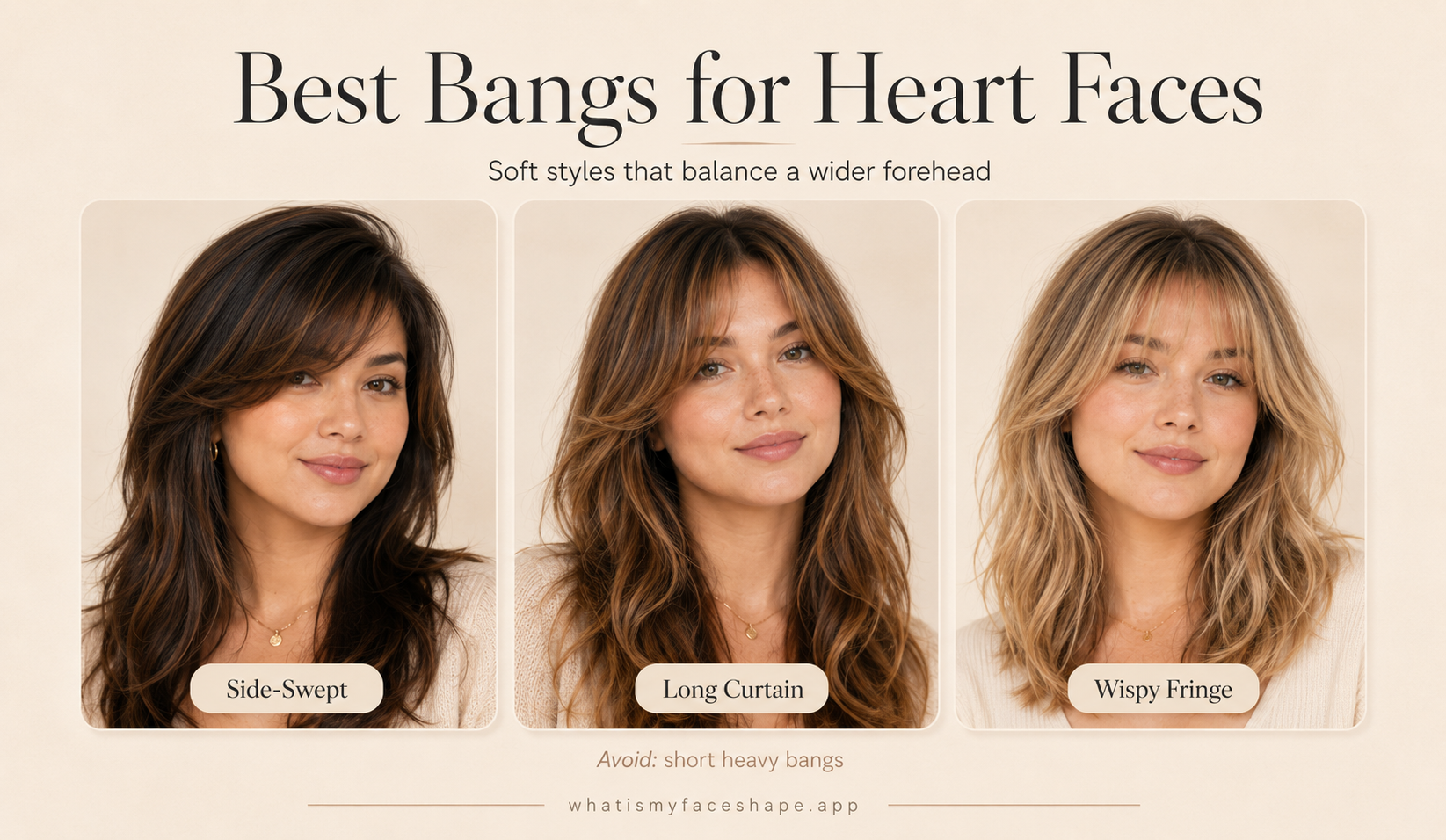
Best picks
Heart faces often have a wider forehead and a narrower chin, so the most flattering fringe pulls attention down and outward. Side-swept and long layered bangs do that naturally. Rounded, wispy fringe can work too, as long as it doesn’t turn into a dense block at the top.
This is the zone where “soft” really means “strategic.” You’re balancing proportions, not hiding your face.
Avoid list
Short, heavy frontal bangs tend to spotlight the forehead, which is the opposite of what most heart shapes want. Unless you’re going for bold contrast on purpose, skip it.
Curtain bang notes
Curtain bangs are friendly to heart shapes when they’re long enough to blend into cheek-level layers. If they’re too short, they can create a little triangle of volume at the top, and then your forehead becomes the main character again.
Which bangs suit an oval face best?
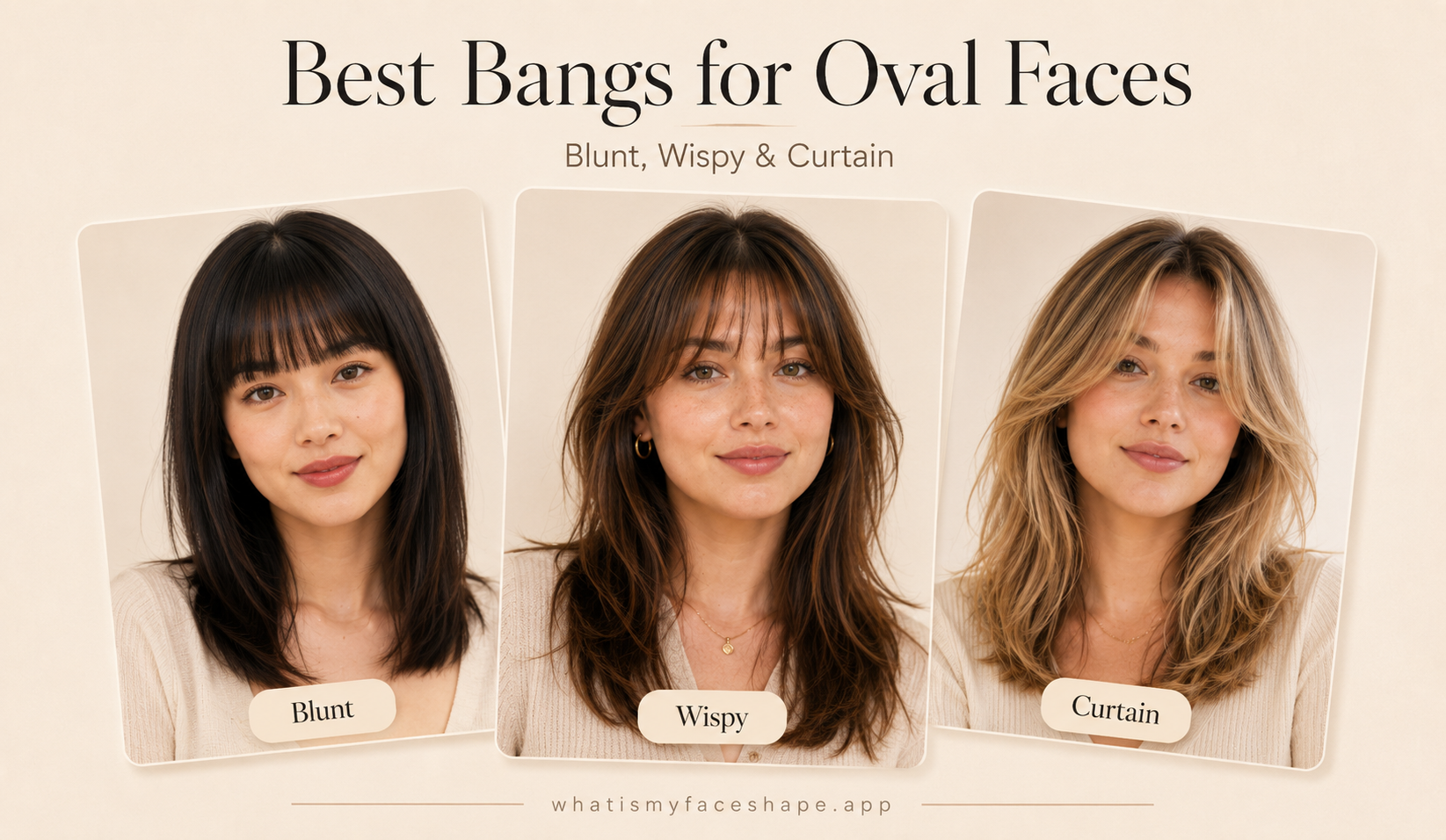
Best picks
Oval faces can pull off almost every bang style, which is both fun and mildly annoying because it doesn’t narrow your options. My go-tos: blunt bangs for a punchy, graphic frame, or wispy bangs for a breezier vibe that still reads intentional.
Avoid list
The main danger for oval shapes is less about “wrong bangs” and more about a mismatch with hair texture and styling patience. Too short plus a cowlick equals regret. Too long with no layering can look like accidental hair fell forward.
Curtain bang notes
Curtain bangs on an oval face are the safest possible bet. If you’re indecisive, start there, live with it, then go shorter if you get bored.
Which bangs suit a long face best?
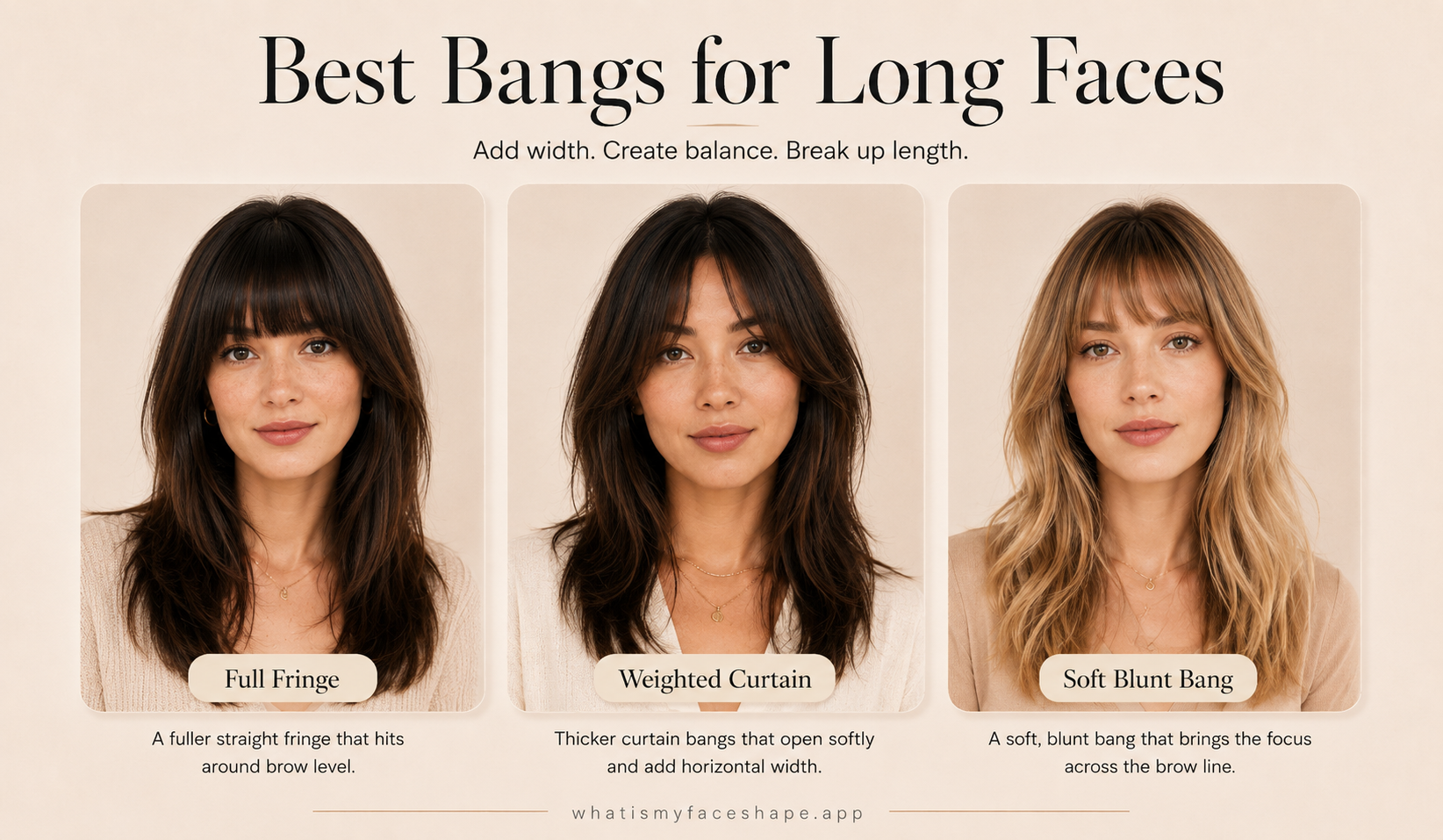
Best picks
Long faces usually benefit from fullness across the forehead because it visually reduces length. A fuller straight fringe, a thicker curtain that actually has weight, even a blunt bang that hits around brow level can bring proportions back into a more balanced range.
Avoid list
Super long, center-parted pieces that hang straight down can elongate even more. Same with thin, stringy fringe that doesn’t create a horizontal break.
Curtain bang notes
Curtain bangs can work on long faces if they start wider and create some horizontal volume. Think “curtain,” not “two sad ropes.” If you need a rule of thumb, you’re trying to add width, not length, which lines up with the broader “inverse geometry” idea used in upper-face styling (this Yahoo Style explanation gets at the concept without being too precious).
When should you avoid bangs?
If you hate daily micro-maintenance, avoid them. If you work out a lot and sweat into your forehead, consider longer fringe you can clip back. If you have oily skin or acne along the hairline, bangs can aggravate it because you’re basically adding a warm hair curtain to your T-zone.
Also, if you have intense cowlicks right at the front, be cautious. A good stylist can cut around them, but not every salon will. And if you’re growing out damage or postpartum shedding, adding bangs can feel like you’re “fixing” the front while the rest is still in recovery, which is emotionally messy.
The simplest filter: if you cannot imagine trimming or styling bangs before a meeting, don’t do short bangs. Do longer ones. Or skip it.
How do you maintain bangs and plan grow-out?
Bangs need trims. That’s the boring truth. Brow-grazing blunt bangs might need a trim every 3 to 4 weeks to stay crisp, especially if your hair grows fast. Wispy fringe is more forgiving. Curtain bangs are the most forgiving, which is why they’re the gateway drug.
Maintenance is also about how you dry them. If you wait until your hair is air-drying in random directions, you’re fighting physics. Wet them, blow-dry them forward, then push them into the shape you want. The first step is always direction.
Grow-out is less painful when your bang style already blends into face-framing layers. That’s why I keep saying “start longer.” When you’re over it, you can slide into a cheekbone-length piece and pretend it was always the plan.
Before you sit in the chair, use whatismyfaceshape.app to understand your face shape and get a clearer idea of which bang styles are likely to work for you. Then bring that result to your stylist as a starting point, not a strict rulebook. The best fringe comes from both: your real proportions and a stylist who knows how to adapt them.
Frequently Asked Questions
Are curtain bangs good for most face shapes? Yes. Curtain bangs are the safest starter option for most faces because the length can be adjusted, the center part creates openness, and the grow-out is easy compared to blunt bangs.
How do I choose the right bang length? Pick the length based on what you want to emphasize: cheekbone-skimming fringe slims the mid-face in photos, brow-grazing looks bold and graphic, and lip-length curtain pieces are the lowest-commitment option.
Do bangs make you look younger? Sometimes. Bangs can shift perceived age because they change how the upper face and forehead are framed, and studies using virtual hair manipulation show appearance judgments can move with hair outlines.
What should I tell my hairstylist? Bring two or three reference photos, describe your morning routine honestly, and say what you’re trying to accomplish: soften a jawline, reduce perceived length, add angles, open the eyes. Outcome language beats “I want trendy bangs.”
Conclusion
If you take nothing else, take this: bangs work when they echo your best features and balance your proportions. Round faces usually want vertical drape. Square faces want softness and texture. Heart shapes want attention pulled down. Oval faces can play. Long faces want a horizontal break.
Then reality shows up: hair texture, cowlicks, density, and whether you’ll actually trim them before they turn into eye lashes. Choose with intent, start with a forgiving length if you’re on the fence, and you’ll get the fun part of a fresh fringe without the panic spiral.