Introduction
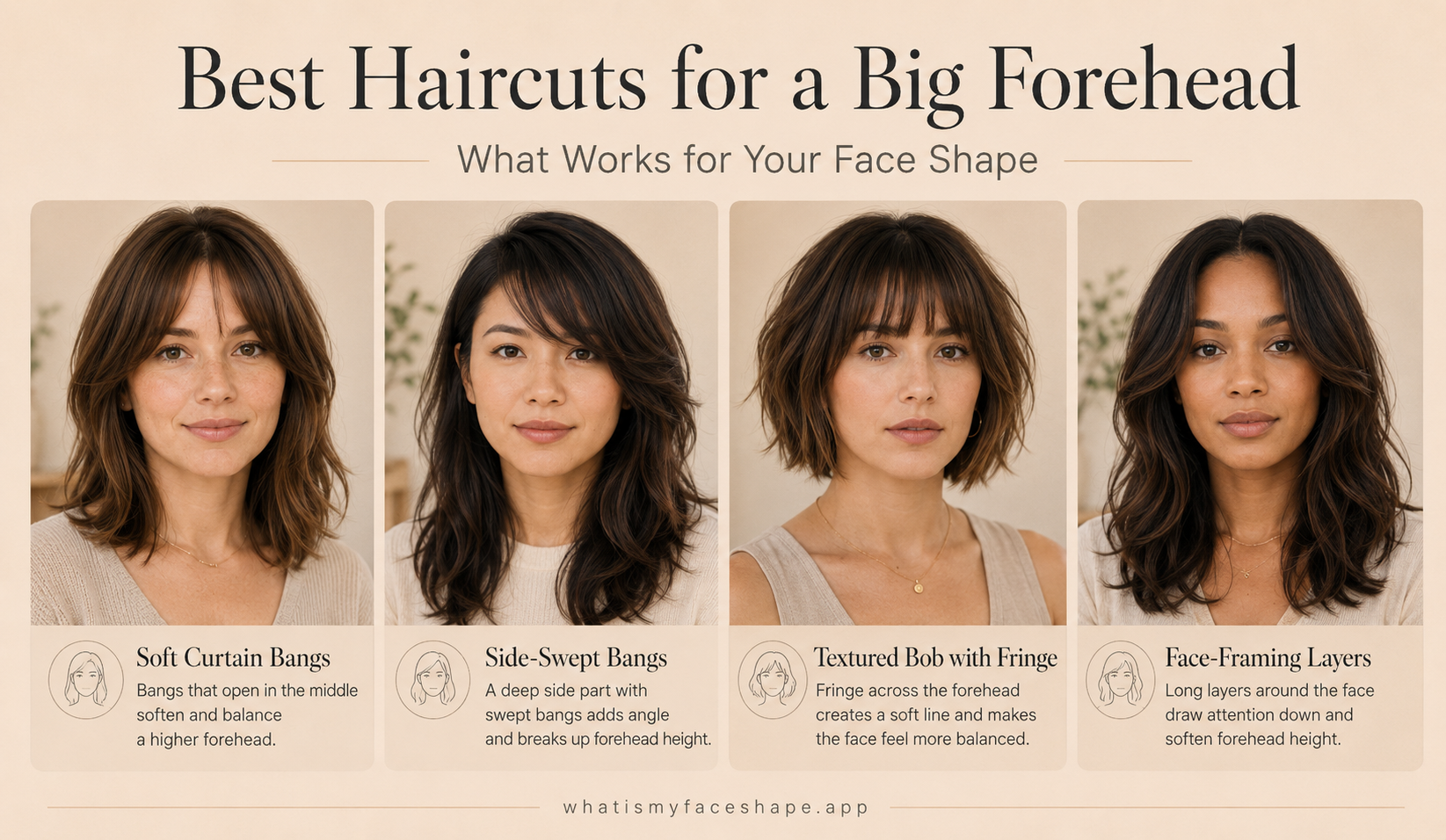
Most people who tell me they have a “big forehead” are actually describing a different problem: their _hair is giving their forehead too much air time_. Fix the frame and the forehead “shrinks.” That’s the game.
So if you want the practical answer upfront, the haircuts that usually work best for a big forehead are the textured crop or French crop (with a soft fringe), a side swept fringe with a crop fade, and a medium, curtain-style fringe if you can stand a little daily styling. Those cuts push visual weight down toward the eyes and cheekbones instead of parking it up at the hairline, which is why they keep winning in real life and not just in hairdresser TikToks.
Now, the annoying part. You can’t pick a cut just from “big forehead.” You pick it from your hairline pattern, your face shape, and your hair type. Get one of those wrong and you’ll be back in two weeks asking why the mirror lied to you.
What counts as a larger forehead?
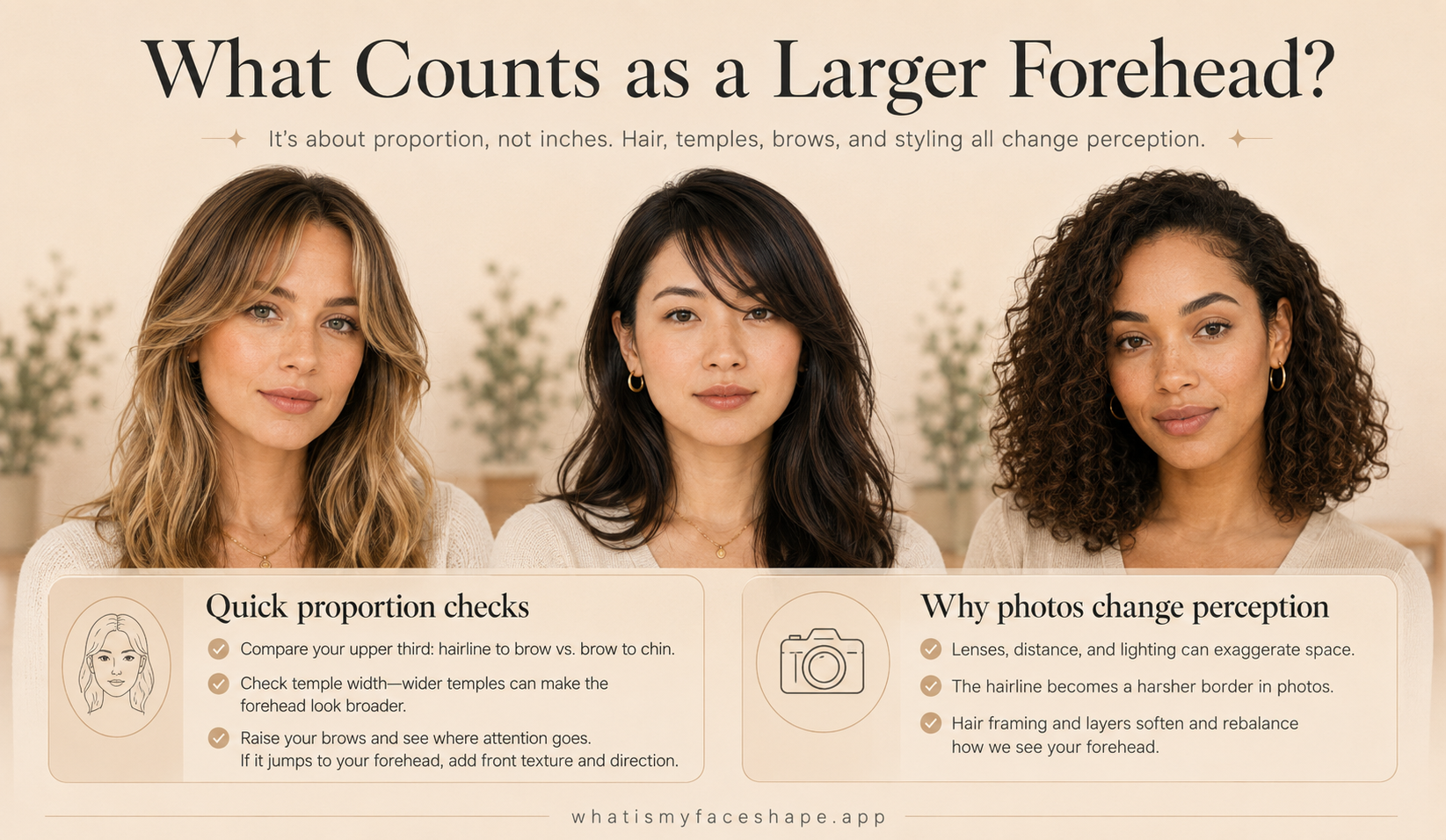
People want a number. Inches. A ruler moment. The truth is your forehead prominence is mostly a proportion problem, not a measurement problem, and it changes depending on your hair density, your temple shape, even your brow ridge. Humans read faces in clusters, not in isolated parts, which is exactly why surrounding hair can swing perception so hard.
Quick proportion checks
If you want a fast read, do it like a hairdresser does it, not like you’re building a spreadsheet.
- Check the “thirds” in a mirror at arm’s length: hairline to brow, brow to base of nose, base of nose to chin. If the top third dominates, your forehead reads bigger, even if it’s totally normal.
- Look at temple width versus cheekbone width. If your temples feel wide and bare, the forehead looks broader, even when height is average.
- Raise your eyebrows and watch where your attention goes. If your eyes get lost and your forehead becomes the headline, you need more front texture and direction.
Also worth knowing: men and women don’t even average the same hairline height, so comparing yourself to your girlfriend, your sister, or your coworker with a middle part is a setup. One paper on sexual dimorphism in hairlines reported average [forehead height]( https://pmc.ncbi.nlm.nih.gov/articles/PMC10325763/) around 4.16 cm for men versus 3.51 cm for women.
Why photos change perception
Photos punish symmetry and exaggerate empty space. A lens compresses or stretches your head depending on distance. Lighting turns the hairline into a hard border. Then you see yourself tagged in a group shot and suddenly you’re Googling “haircuts for high forehead” at 1:00 a.m.
There’s also the social side: hair reads as a controllable cue, and people make snap judgments from it, including cues like dominance and competence. If you want the rabbit hole, this 2026 paper on hair and social judgments explains why a haircut can change how you’re read in a room.
Choose a cut by hairline pattern
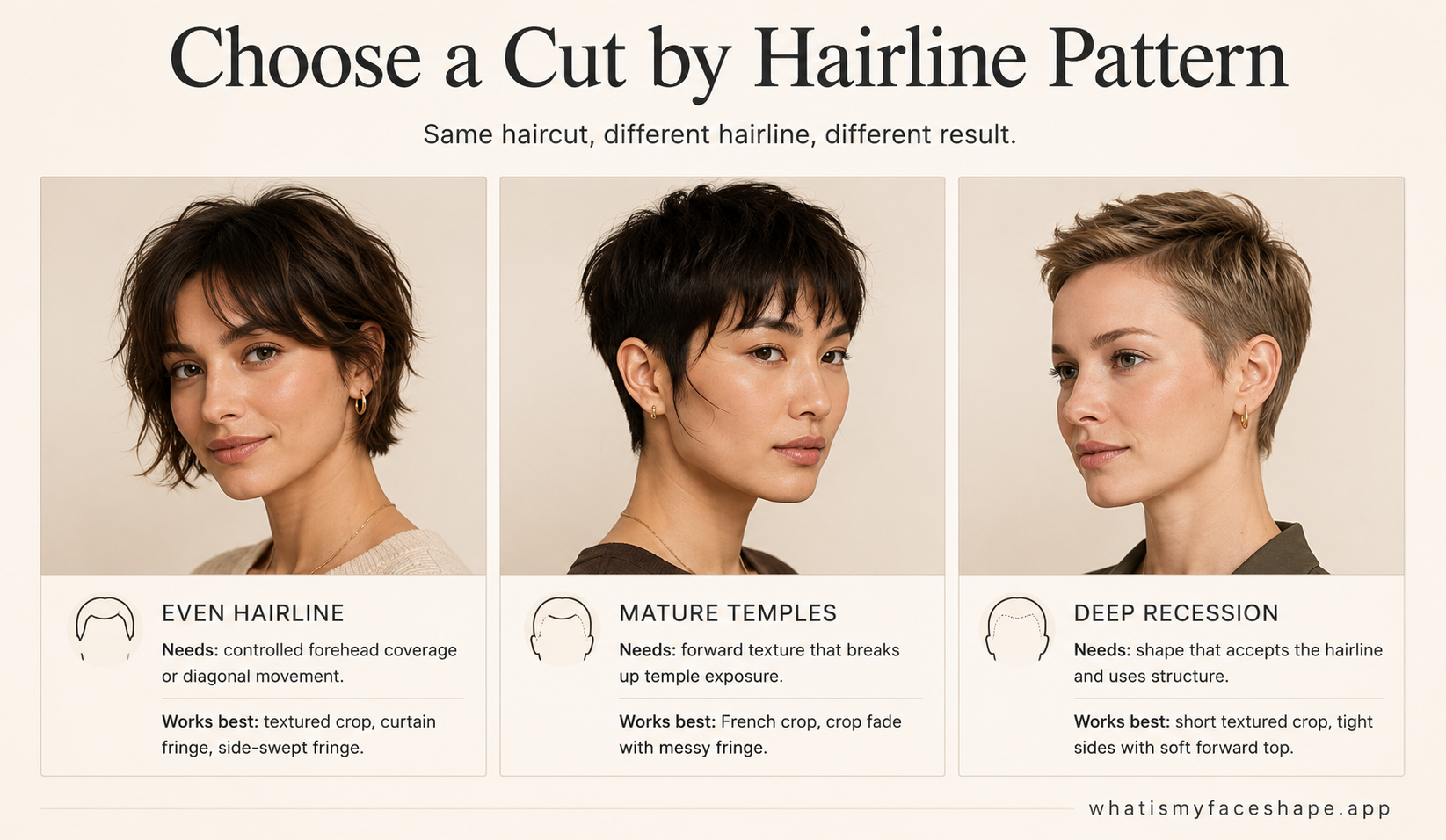
Hairline pattern is the quiet boss here. Same haircut, different hairline, totally different result.
| Hairline pattern | What it usually needs | Cuts that tend to work |
|---|---|---|
| Even hairline | Controlled forehead coverage or diagonal movement | Textured crop, curtain fringe, side swept fringe |
| Mature temples | Forward texture that breaks up temple exposure | French crop, crop fade with messy fringe |
| Deep recession | Style that accepts the hairline and uses shape, not denial | Short textured crop, tight sides with soft forward top, very controlled buzz variations |
Even hairline
If your hairline is even and you just have a broad forehead, you’re in the “easy mode” category. You can do fringe without it looking like you’re hiding. The move is softness. Movement. A front edge that isn’t one harsh line.
This is where my bias shows: I like coverage, but I hate heavy, straight-across bluntness for a lot of faces because it can make the upper face feel chopped into a separate zone.
Mature temples
A mature hairline is common, often attractive, and not automatically “balding.” The problem is when you pick a cut that exposes the temples _and_ adds height, because that combo pulls attention up and out.
For mature temples, the best cuts tend to send the top forward or diagonally forward. Not flat. Not pasted. Just enough to break up the outline.
Deep recession
Deep recession is where the internet starts selling fantasy. You can’t fringe your way into a teenage hairline if your corners are way back and density is dropping. You can, however, create a balanced look that looks sharp and intentional.
Your friend here is texture, matte finish, and a clean shape that doesn’t depend on a perfect front line. Keep the sides neat. Keep the top controlled. Let the hairline exist without spotlighting it.
Choose a cut by face shape
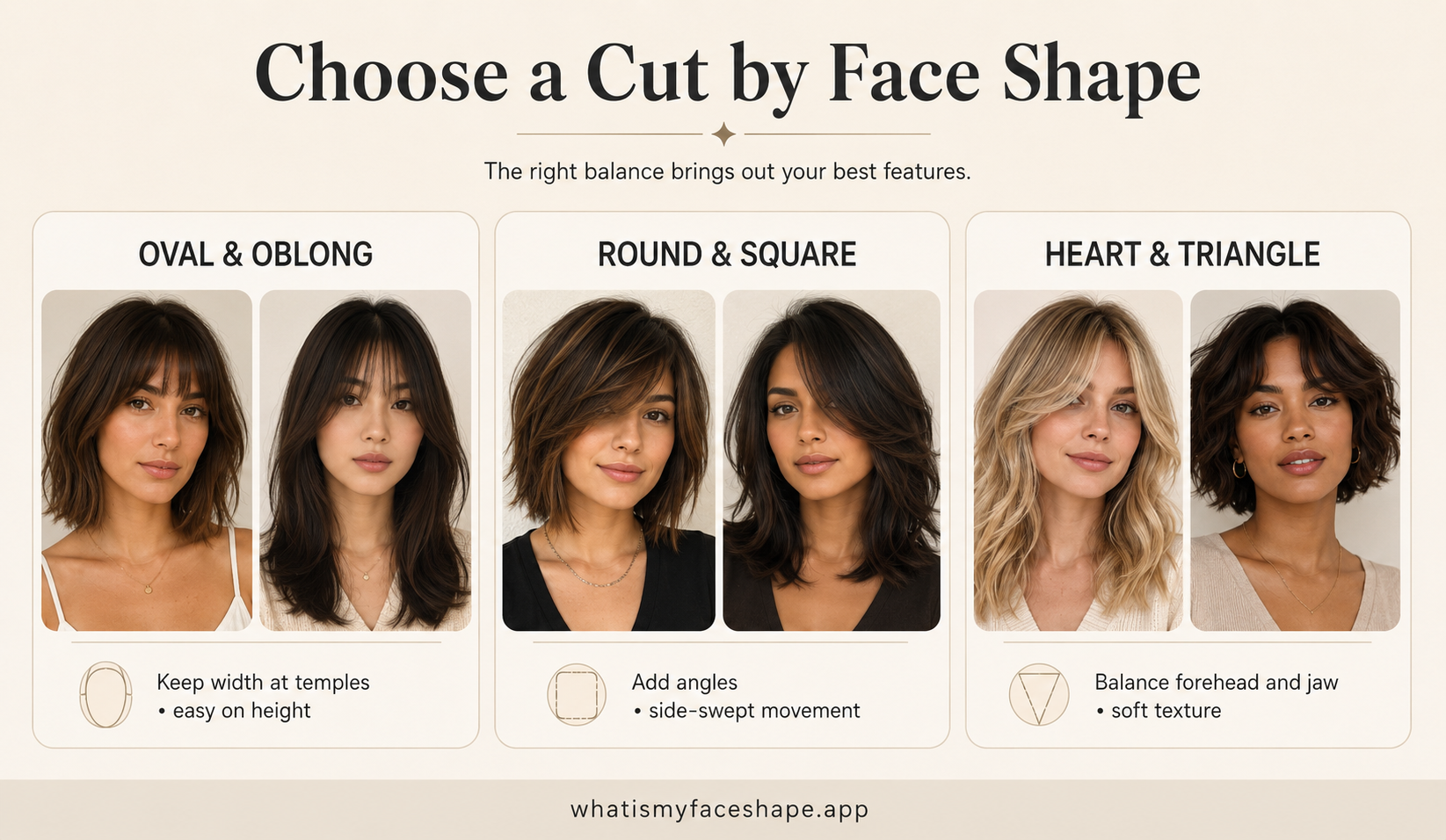
Face shape doesn’t need to be a personality test. It’s a balance problem.
Oval and oblong
Oval faces can wear almost anything, which is why the worst thing an oval-faced guy can do is pick a cut that makes his face look longer for no reason. If you’re oblong or have a long face shape, go easy on height and keep some width around the temples. A crop with a textured fringe is usually safer than a tall quiff.
Round and square
Round faces need length and angles, but not fake height that makes the forehead feel taller. Square faces can handle structure, but a hard part paired with a slick back can make the forehead read like a billboard.
The sweet spot for both is diagonal movement in front and controlled width on the sides. A side swept fringe is quietly one of the best tools here because it draws the eye across instead of up.
Heart and triangle
Heart shape usually means wider forehead, narrower jaw. Triangle tends to be the opposite. If you’re heart-shaped, front coverage and cheek-level movement help, and adding bulk on the sides can backfire because it widens the top even more.
If you’re triangle, you can afford a bit more volume up top, but keep it textured and wearable, not helmet-like.
Best options that rebalance the frame
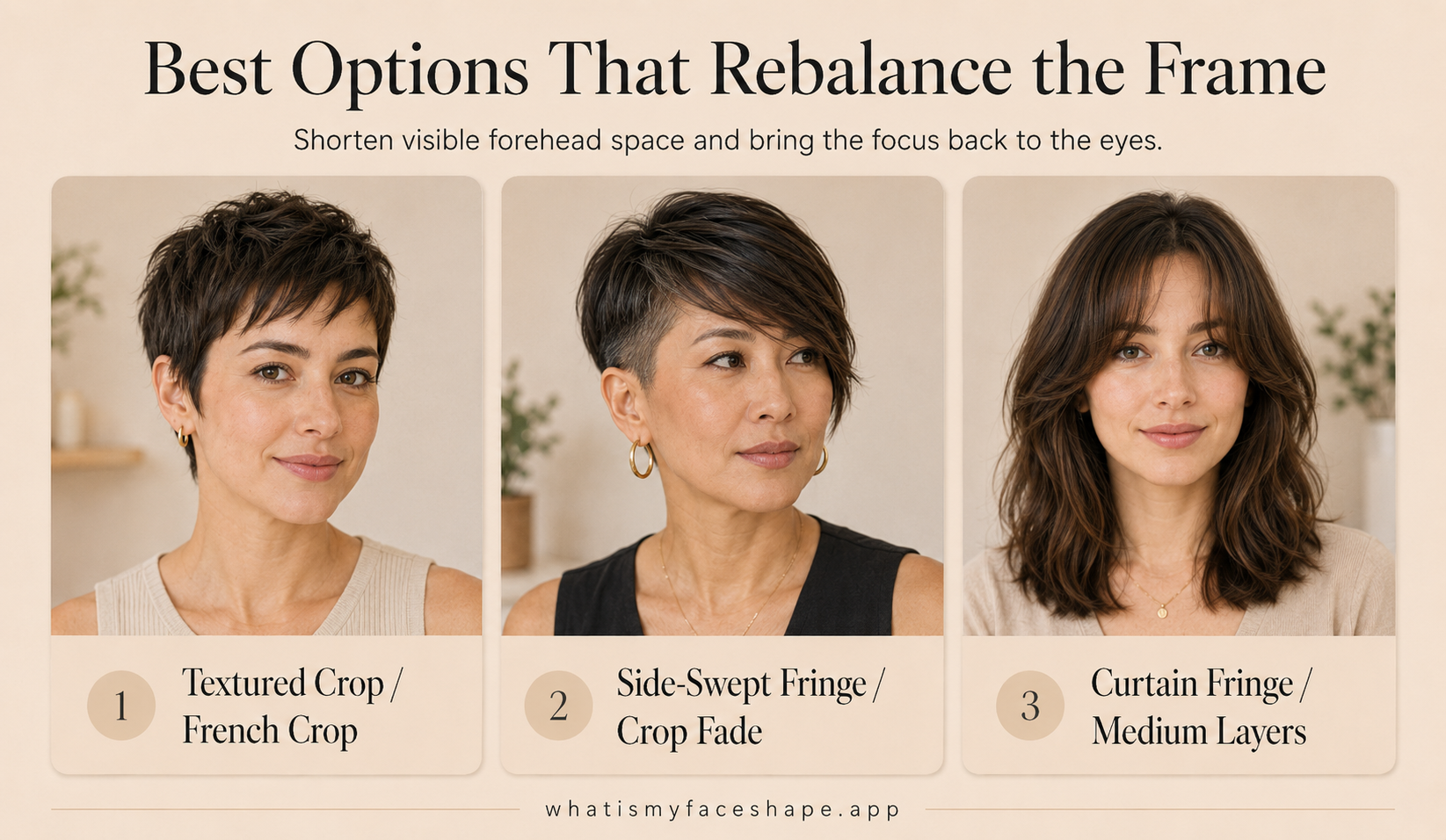
You’re trying to do two things at once: shorten the visible forehead and create proportion so your eyes sit at the center of the story.
Textured crop and French crop
The textured crop is basically the workhorse haircut for big foreheads. It’s short, masculine, and doesn’t beg for perfect styling. The French crop is the slightly cleaner cousin, often with a more defined fringe area.
Key detail: the fringe should be textured and uneven, not a straight ruler line. Think piecey bangs, not kindergarten bangs.
Side-swept fringe and crop fade
Side swept fringe is underrated because it sounds like something from a teen drama, but the mechanics are elite. The diagonal line breaks up forehead width. It adds movement. It gives you control over how much forehead coverage you want day to day.
Pair it with a crop fade if you want the sides tighter without looking like you’re inflating the top. Ask for a low to mid fade if your forehead is the concern. High fades can exaggerate the top third.
Curtain fringe and medium layers
Curtain fringe on men works when it’s not fussy. A soft center part, fringe that falls to split the space, and medium layers that keep it from sitting like a flat sheet.
This is also where you can cheat proportion by starting layers lower, closer to cheek or jaw level, so the eye drops down. It’s the same reason curtain bangs work for so many people across genders, and why “haircuts for high forehead” searches often overlap with “bangs for big forehead” even when the person asking is a guy.
Match fringe to hair type
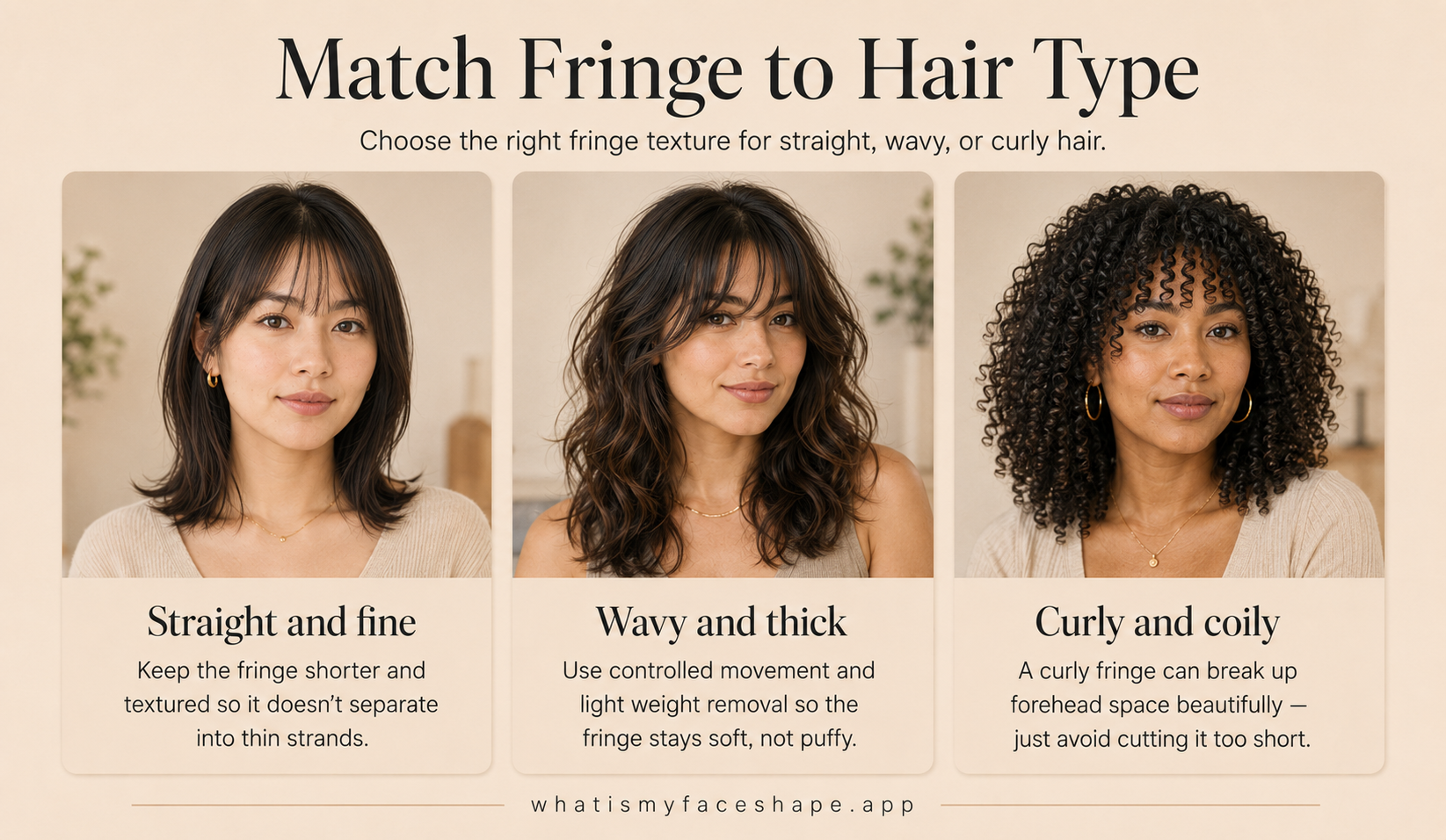
Hair type decides whether fringe behaves or misbehaves. You can’t argue with physics.
Straight and fine
Fine hair gets bullied by gravity and scalp shine. You want texture without stringiness. Keep the fringe shorter, add point cutting, and style with a matte clay or a light styling cream. If you go too long, it separates into sad strands and suddenly your forehead is back.
Wavy and thick
Wavy, thick hair is honestly a gift for this problem. You get built-in movement. Ask for internal weight removal so the fringe doesn’t puff and create height. The goal is control and direction, not bulk.
If your hair is thick and you insist on a slick back, you can pull it off, but you’ll be highlighting the hairline by design. Own it or skip it.
Curly and coily
Curly fringe can be amazing for big foreheads because the curl pattern breaks up space naturally. The mistake is cutting it too short while dry-shrunk, then discovering you have micro-bangs and maximum forehead visibility.
With coily hair, shape matters more than “cover.” A forward-leaning top with a gentle line and clean sides can balance the head without forcing the hair to do something it won’t.
| Hair type | Fringe approach | Product and tool that helps |
|---|---|---|
| Straight, fine | Shorter, textured, slightly angled | Matte clay plus a round brush for lift at the root |
| Wavy, thick | Medium, broken up, weight removed | Sea salt spray plus light paste |
| Curly, coily | Longer when dry, shaped forward | Curl cream plus diffuser for controlled volume |
Avoid these styles and common mistakes
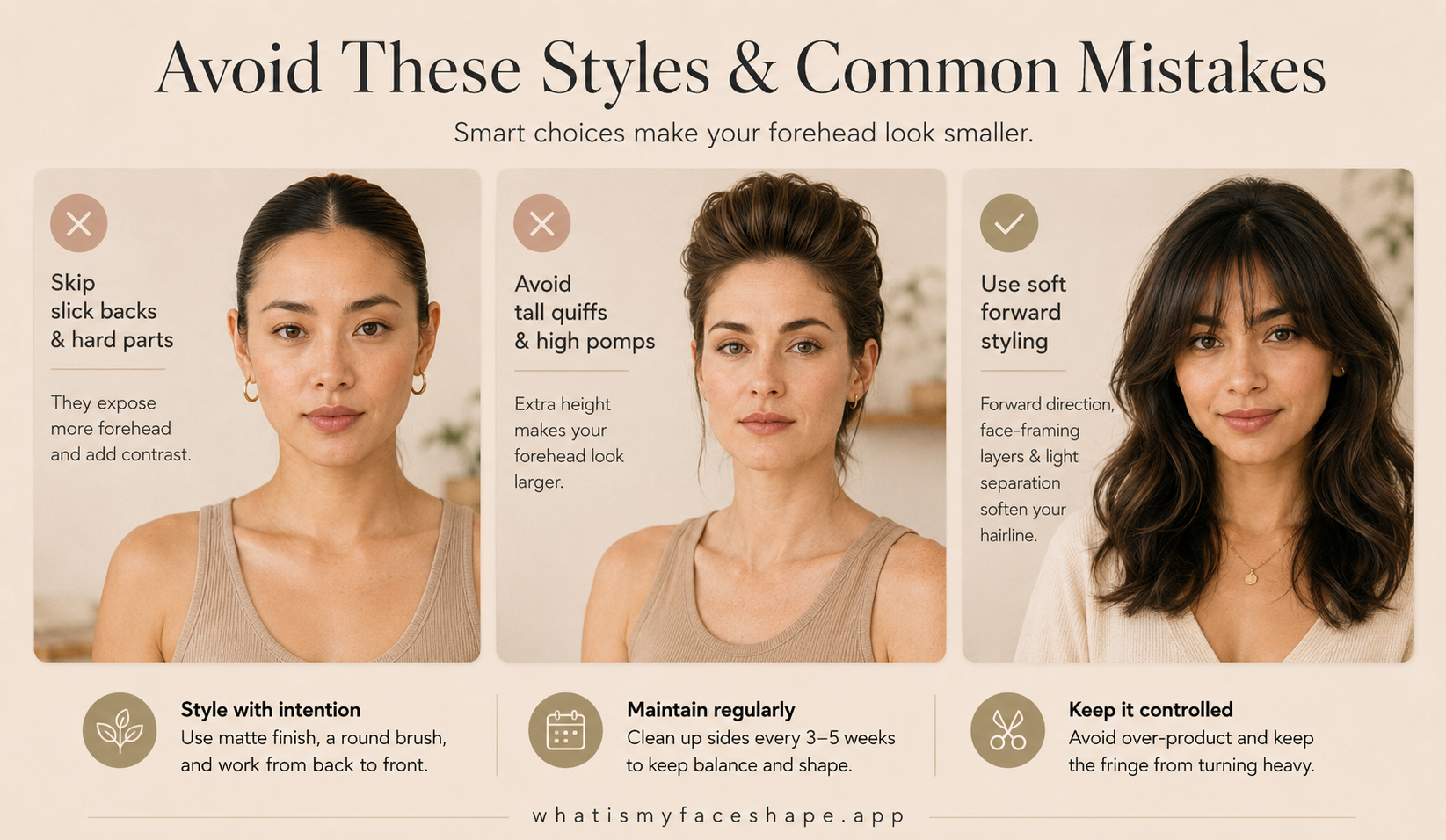
This is the part nobody wants, because it’s the “stop doing that” section. Still, it saves you money.
Slick back and hard parts
Slick backs create a clean line from hairline to crown. Clean line equals maximum attention to the forehead. Hard parts add contrast and geometry, which also draws the eye up.
If you love that style, fine, but don’t act surprised when your forehead looks bigger. You designed it that way.
Tall quiffs and high pomps
Height is a multiplier. If you already think your forehead is tall, stacking more height above it is like underlining the problem.
A little lift is okay, especially for round faces, but the modern “sky quiff” with tight sides is basically a forehead megaphone.
Style and maintain for a smaller-looking hairline
The cut is the foundation. Styling is the daily vote you cast for the look you want.
If your goal is a smaller-looking hairline, you usually want matte finish, forward direction, and controlled separation. A tiny amount of product, emulsified fully in your hands, then worked from back to front so you don’t overload the fringe. Blow-dry matters more than product for most men, and a round brush is the cheat code for getting root lift without turning it into a pompadour.
Maintenance is the unsexy part. Crops need consistent cleanup on the sides every 3 to 5 weeks so the balance stays intact. Medium layers can go longer, 6 to 10 weeks, but you have to keep the fringe from turning into a curtain you fight all day.
Tell your hairdresser exactly what you want
Most miscommunication happens because people ask for a haircut name instead of a haircut outcome. Your hairdresser hears “French crop” and pictures favorite version, not the one that fixes your proportions.
So say what you’re trying to achieve, then describe the mechanics.
- Tell them the goal: “I want my forehead to read smaller and my face to feel more balanced.”
- Tell them the direction: “Keep the top moving forward or slightly to the side, not up and back.”
- Tell them the edge rule: “Make the fringe textured and soft, not a straight line.”
- Tell them the sides: “Low to mid taper or fade, nothing too high.”
If you’re nervous, bring two photos. One that you like for the top, one that you like for the sides. Photos save everyone.
Frequently Asked Questions
Do bangs work for a big forehead on men? Yes, when they’re textured and a little irregular. Heavy, blunt, straight bangs can look like a helmet and often make the top of the face feel more separate.
What if I have a high forehead and straight, fine hair? Keep the fringe shorter and piecey, use matte product, and avoid shiny gels. Fine hair that’s too long in front splits and exposes the forehead anyway.
Why do “hairstyles for big forehead female” and men’s searches overlap? Because the visual trick is the same: face-framing, diagonals, and controlled forehead coverage. Gender changes the typical cut names and finishing, not the geometry.
Conclusion
You don’t win this by “hiding” your forehead. You win it by making the whole head read as one intentional composition. A textured crop, a side swept fringe, or a wearable curtain fringe can do that fast, but only if you pick based on your hairline pattern, your face shape, and your hair type, then actually style it like you meant it. If you do nothing else, stop pushing everything straight back and acting confused when your forehead becomes the main character.