Introduction
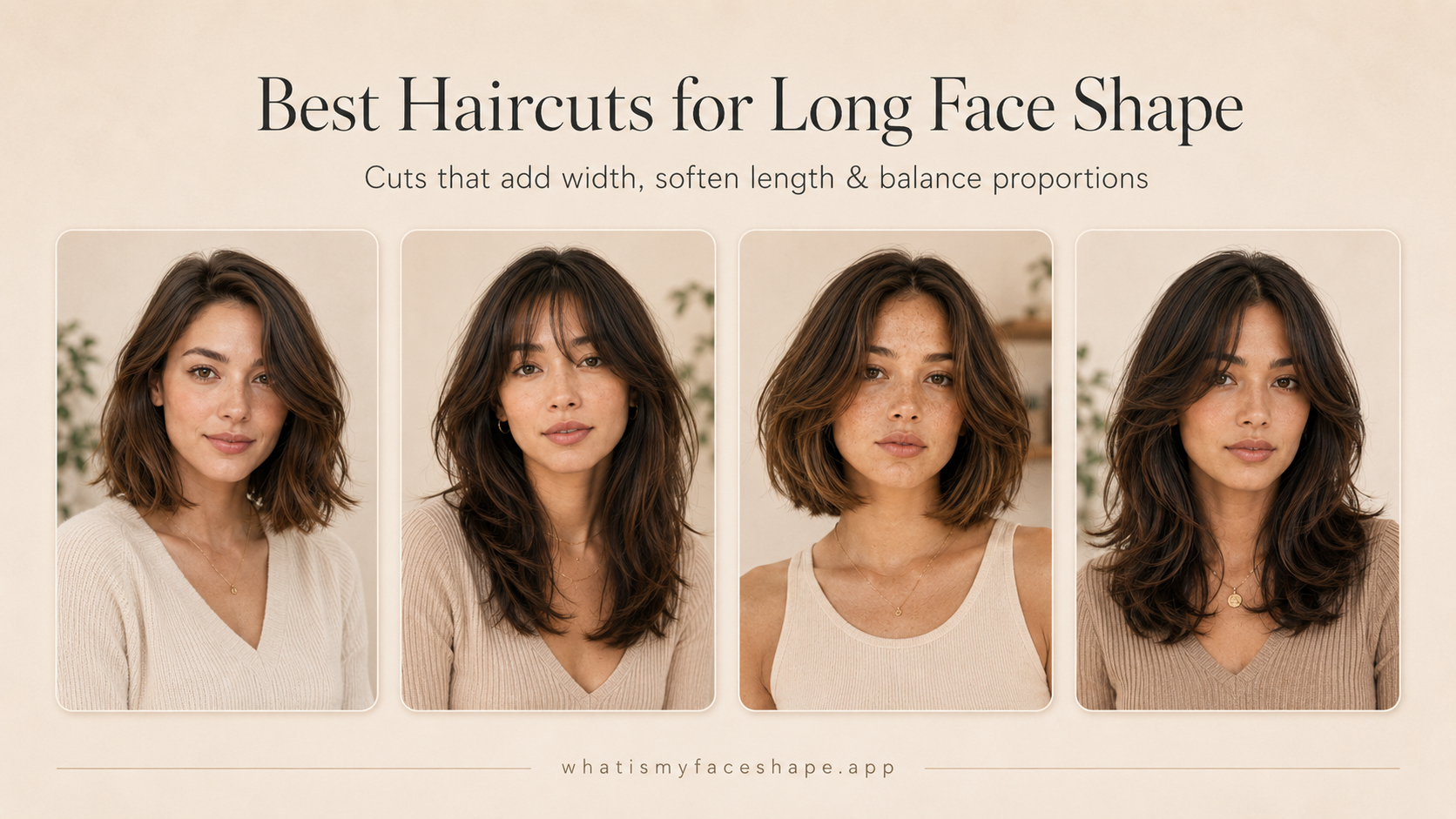
If you keep getting a “pretty” cut that somehow makes your features look longer and narrower, you’re not being picky. You’re bumping into geometry. The best haircuts for a long (oblong) face shape are the ones that create horizontal emphasis: they add width around the cheekbones and jawline, break up forehead length with a bang, and keep volume on the sides instead of stacking height at the crown.
That’s the whole game. Not “slimming,” not “snatching,” not chasing whatever is trending on your feed this week. Balance. Real-life balance, under real-life lighting, when your hair decides to do its own thing.
How do you know you have a long face?
Quick self-check
You can check your face shape at home, but first: stop trusting selfies taken with a wide-angle lens. They can stretch the center of the face, shrink the sides, and make your proportions look different from real life.
If you want to do it manually, use a soft tape measure and check four points:
1\. Forehead width: temple to temple
2\. Cheekbone width: widest point across the cheeks
3\. Jaw width: corner to corner
4\. Face length: hairline to chin
If your face length is noticeably larger than the width across most points, you may be in long-face territory. If the length is much greater than the width, you may be closer to an oblong face shape.
You can also try the mirror method: pull your hair back, look straight ahead, and trace the outline of your face with a washable marker or dry-erase pen. It is simple, slightly humbling, and often clearer than staring at selfies.
But if you want the easier route, use whatismyfaceshape.app. The app helps you check your face shape faster, so you are not guessing from angles, lighting, or one “good” photo. Once you know whether your face is long, oblong, oval, round, square, heart, or diamond, it becomes much easier to choose a haircut that balances your real proportions.
Common lookalikes
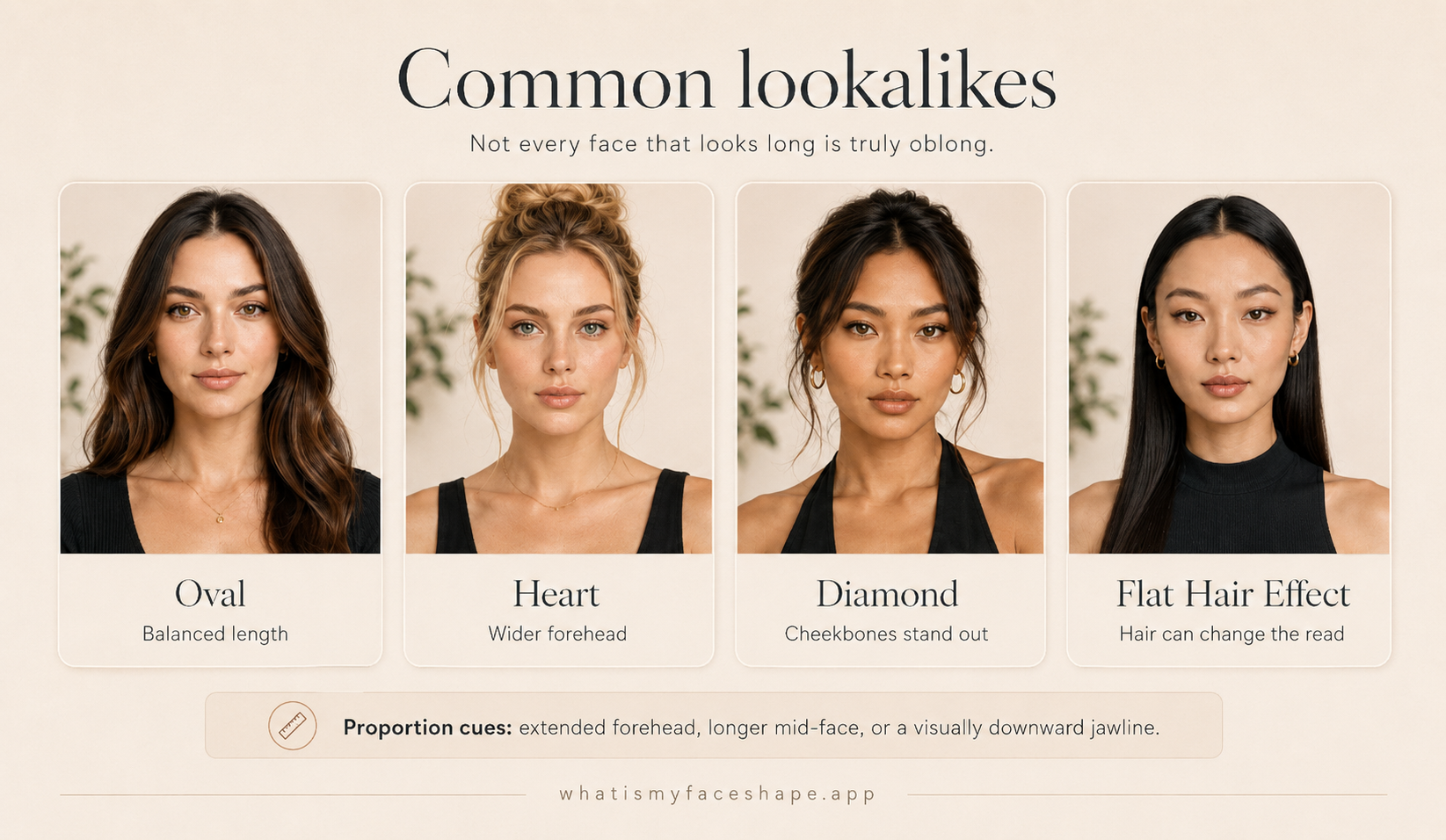
A lot of people think they have a long face when they actually have a different situation causing the same vibe, like a narrow jaw, a higher forehead, or just very flat hair.
Here’s the difference that matters for your haircut, not for your identity:
| Looks similar to long/oblong | What you’ll notice | Haircut focus that actually helps |
|---|---|---|
| Oval | Balanced width, softer jaw, length but not “stretched” | You can handle more center parts and longer lengths without it looking severe |
| Heart | Wider forehead, narrower chin | Side fullness and jaw-level shaping so the lower third doesn’t disappear |
| Diamond | Wide cheekbones, narrower forehead and jaw | Softer layers near the jaw, controlled volume at temples |
| “Long because flat hair” | Features feel longer only when hair is sleek | Volume placement and bend matter more than chopping inches |
Proportion cues
Long faces usually read as: extended forehead, longer mid-face, more distance from nose to chin, or a jawline that feels visually “downward.” None of that is bad. It just means the wrong haircut goes full exclamation point on the vertical length.
A good stylist will look at bitemporal width (temple area), cheekbone width, and jaw shape, not just the outline of your head, which is the same idea discussed in this quick bone-structure mapping breakdown.
Use these haircut principles to balance proportions
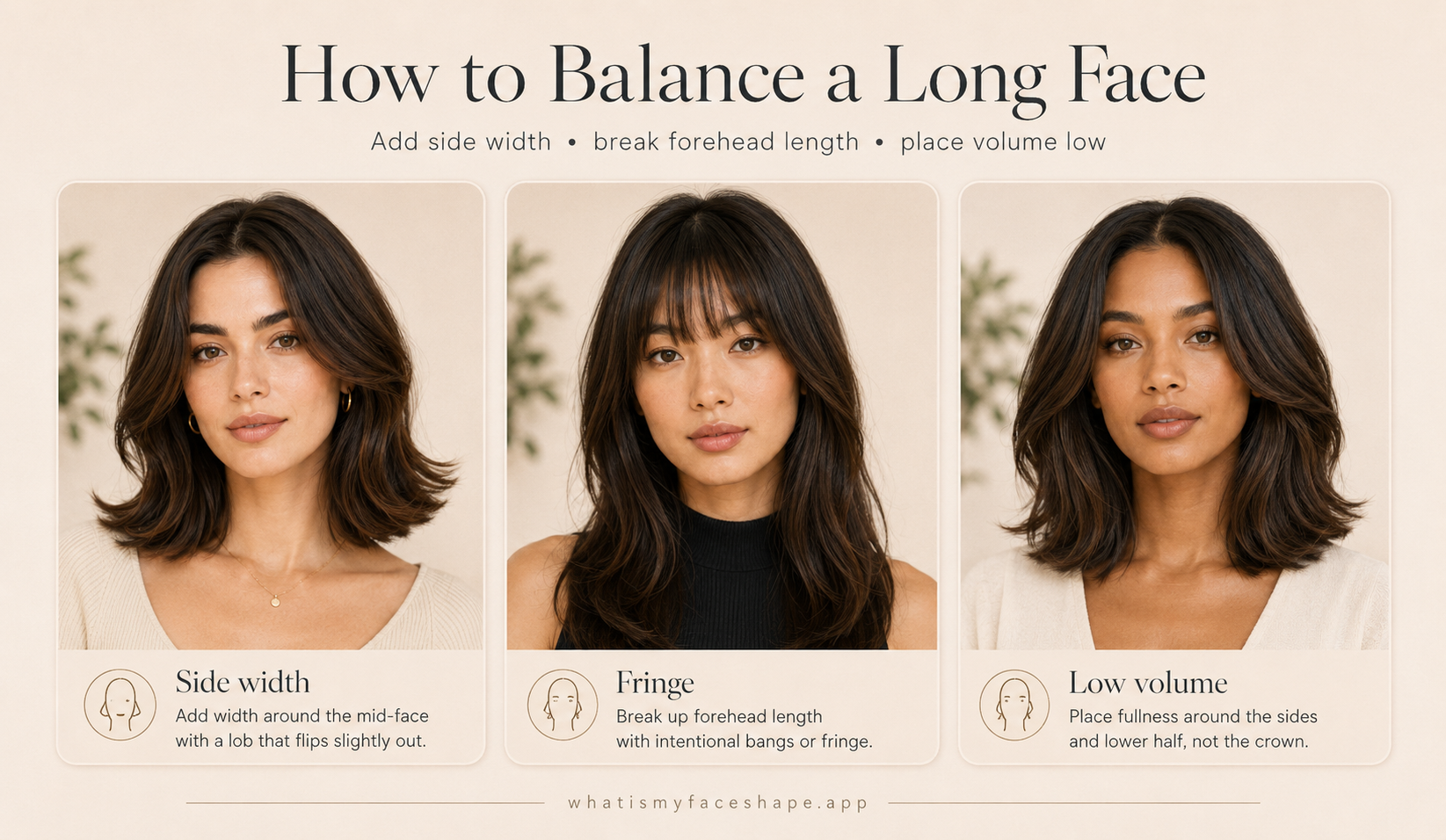
Add side width
For long faces, side volume is not optional. The silhouette has to widen somewhere around the mid-face, which lines up with what educators call the horizontal silhouette principle. If your cut collapses along your cheeks, the eye travels down. If it pushes outward a bit, the eye pauses. That pause is your best friend.
This is why a lob that flips slightly outward can be more flattering than “mermaid hair” that hangs straight like curtains. Curtain hair is cute. Curtain hair plus an oblong face plus flat roots can look… severe.
Break forehead length
Bangs are the cheat code. I’m not delicate about it.
When you add a fringe, you literally reduce the exposed vertical real estate of the forehead, and cosmetology programs teach the same visual logic in their balance guidelines for long faces. The practical takeaway is simple: if your face reads long, you want a line that cuts across the top third.
That can be blunt. That can be airy. It just needs to be intentional, not two sad wisps that separate by lunchtime.
Place volume low
Long faces get punished by crown height. A lot of people hear “volume” and immediately tease the top like it’s 2006, then wonder why everything looks longer.
If you want lift, build it through the sides and mid-length, not straight up. Think cheekbones to jawline. That’s where you want extra fullness, especially if your hair is fine and tends to lie there quietly like a limp ruler (I’ve lived this).
Choose bangs that shorten the face fastest
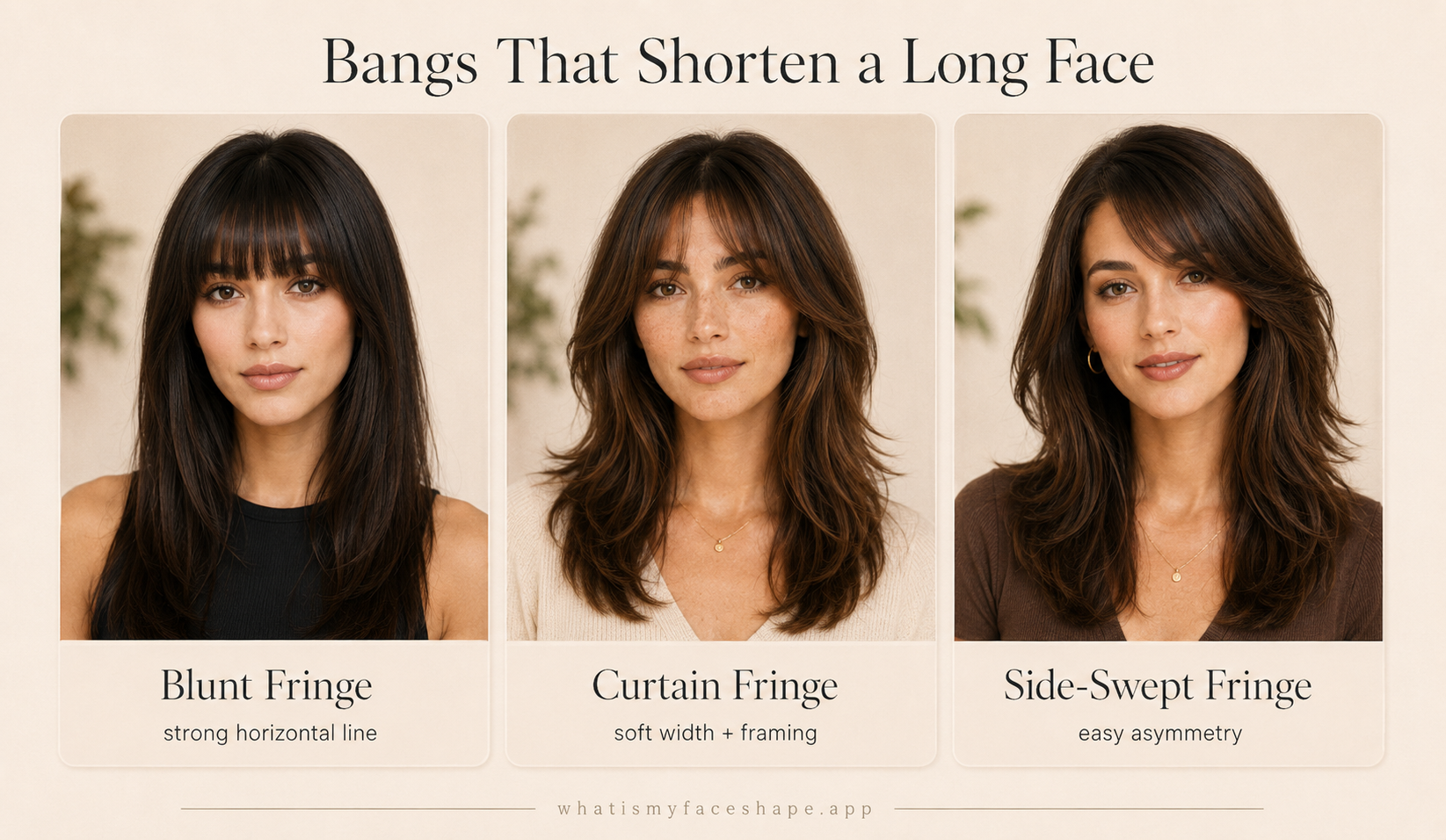
Blunt fringe
Blunt bangs are the fastest way to make a long face read more balanced, because they create a clean horizontal line right across the brow area. They’re especially good if your forehead is tall or you like a sharper, fashion-y vibe.
The trick is density. A blunt bang that’s too thin turns into see-through strings and you lose the visual “shortening.” If you have fine hair, ask your stylist to keep the bang heavy enough to look deliberate, then texturize the ends lightly so it doesn’t sit like a helmet.
Curtain fringe
Curtain fringe is the friendliest option for most people because it still breaks length, but it also frames the cheeks and blends into layers. If you’ve ever screenshotted _dakota johnson curtain bangs_ and thought, yeah, that’s the vibe, you’re not alone.
Curtain bangs work best when the shortest point hits around the brow to upper cheek area, then sweeps down and out. If they start too long, they stop doing the job and just become face-framing layers that drag downward.
This is also why I like the way some stylists explain long-face friendly shapes over at Goodto’s long-face hairstyle guide. They keep coming back to interruption and width, not “fixing” your features.
Side-swept fringe
Side-swept bangs are underrated for long faces because they add asymmetry, which keeps the eye moving across your face instead of up and down it. They’re also a solid choice if you wear glasses, since they can be shaped to sit above the frames without constantly tangling into your lashes.
If you’re bang-curious but low-commitment, side-swept is usually the least annoying grow-out.
To make this practical, here’s a quick comparison:
| Bang type | Best for | Styling reality |
|---|---|---|
| Blunt | Strong shortening, high foreheads, sleek looks | Needs trims and a quick daily set so it doesn’t split |
| Curtain | Soft framing, most textures, easier grow-out | Needs a little bend or blowout to look “done” |
| Side-swept | Glasses wearers, cowlicks, asymmetry lovers | Easier day-to-day, can get long and start dragging if not maintained |
Pick lengths that stop the vertical “drag”
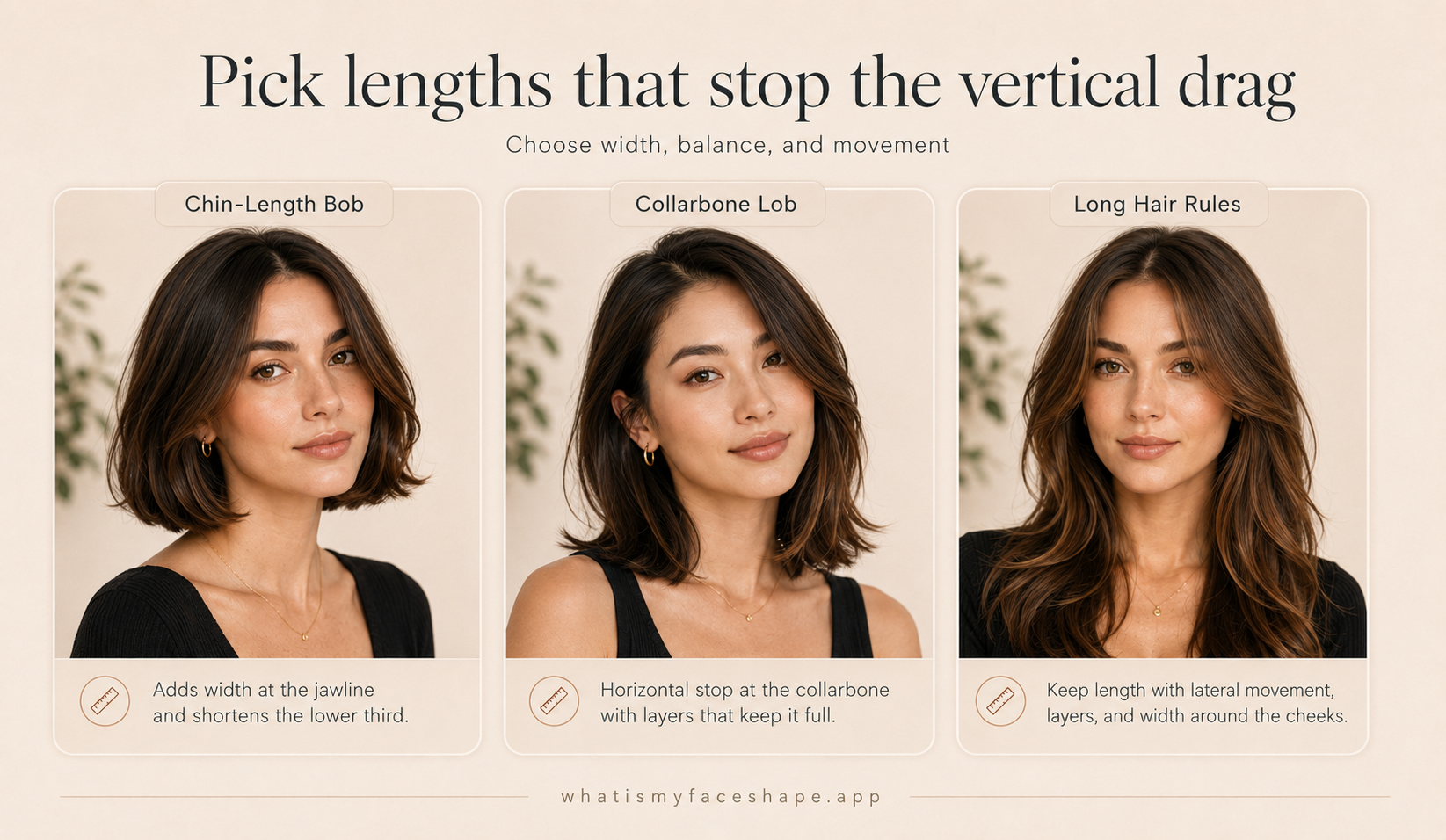
Chin-length bob
A chin-length bob is basically a geometry hack. When the perimeter hits at the jawline, it adds width to the lower third and makes the face look less elongated. It’s why the classic French-ish bob keeps showing up in professional recommendations.
If you’re doing a chin-length bob, ask for a subtle inward bevel or a soft wave, because pin-straight plus tucked-behind-ears can erase the width you just paid for.
Collarbone lob
The collarbone lob is the safest “most people will look better” option for long faces, especially with face-framing layers and a side part. The cut creates a strong horizontal stop at the collarbone, then the layers keep the sides from collapsing inward.
This is also where your density matters. Thick hair needs internal weight removal so the lob doesn’t turn into a triangle. Fine hair needs enough bluntness at the bottom so it doesn’t look stringy.
Long hair rules
You can keep your length. You just need rules, because long and straight with a center part can exaggerate vertical length in a way that looks elegant on camera and oddly harsh in real life.
If you insist on staying long, I like thinking in “where do I want width?” terms, which is exactly why guides like this long-face haircut overview tend to push shoulder-ish shaping and face framing. Long hair can work when it has lateral movement: big loose curls, a bend through the mid-shaft, or layers that kick out around the cheeks.
If you’re trying to decide whether going shorter is worth it, the old-school 5.5 cm rule is a fun reference point, even if you treat it like a suggestion, not a law.
Ask for layers that add width at cheek and jaw
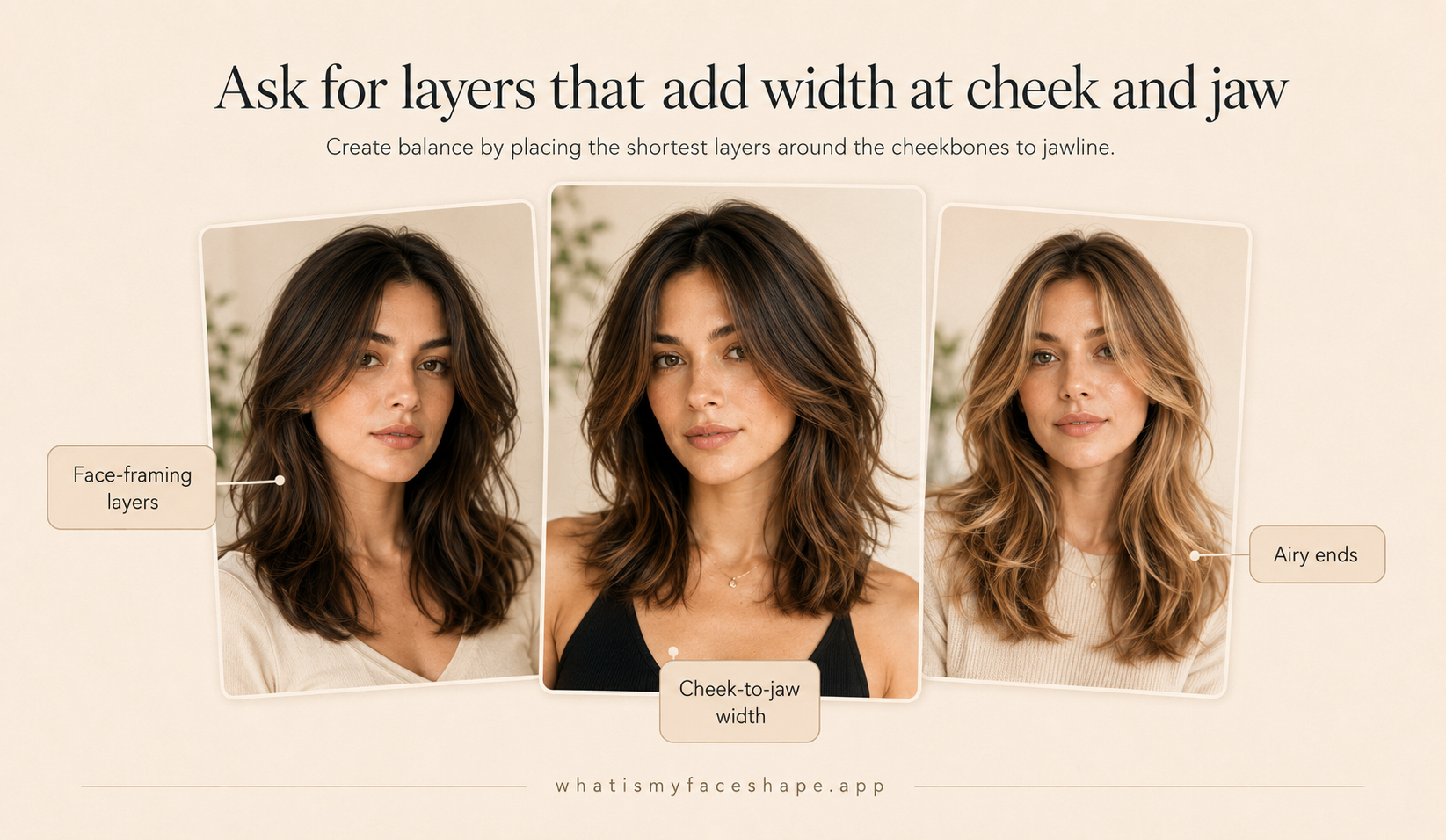
Face-framing layers
Face-framing layers are where a long-face haircut either becomes flattering or becomes a sad waterfall. You want the shortest layer to land somewhere around the cheekbone to jaw area, because that’s where you’re trying to create visual fullness.
A good request sounds like: “Can we keep the face framing wide, not vertical?” If they start the shortest pieces too low, everything points down and you get the dragged effect again.
Texture and ends
Long faces usually do better with ends that have some air. Blunt ends can be great on a bob or lob, but on longer lengths, a tiny bit of texture at the perimeter helps the hair move sideways instead of hanging straight.
If you have fine hair, don’t let someone over-layer you into see-through ends. If you want proof that this is a common trap, the advice in this fine-hair long-style roundup echoes the same warning: you want structure, not scarcity.
Avoid long vertical lines
This is where the center part obsession can betray you. A dead-straight middle part with long hair and no fringe creates two strong vertical panels that frame the face like parentheses. Pretty parentheses. Still parentheses.
If you love a middle part, keep it, but give the front pieces a bend and make sure your layers kick out around the cheekbones, not past the shoulders.
Match your cut to your hair texture and density
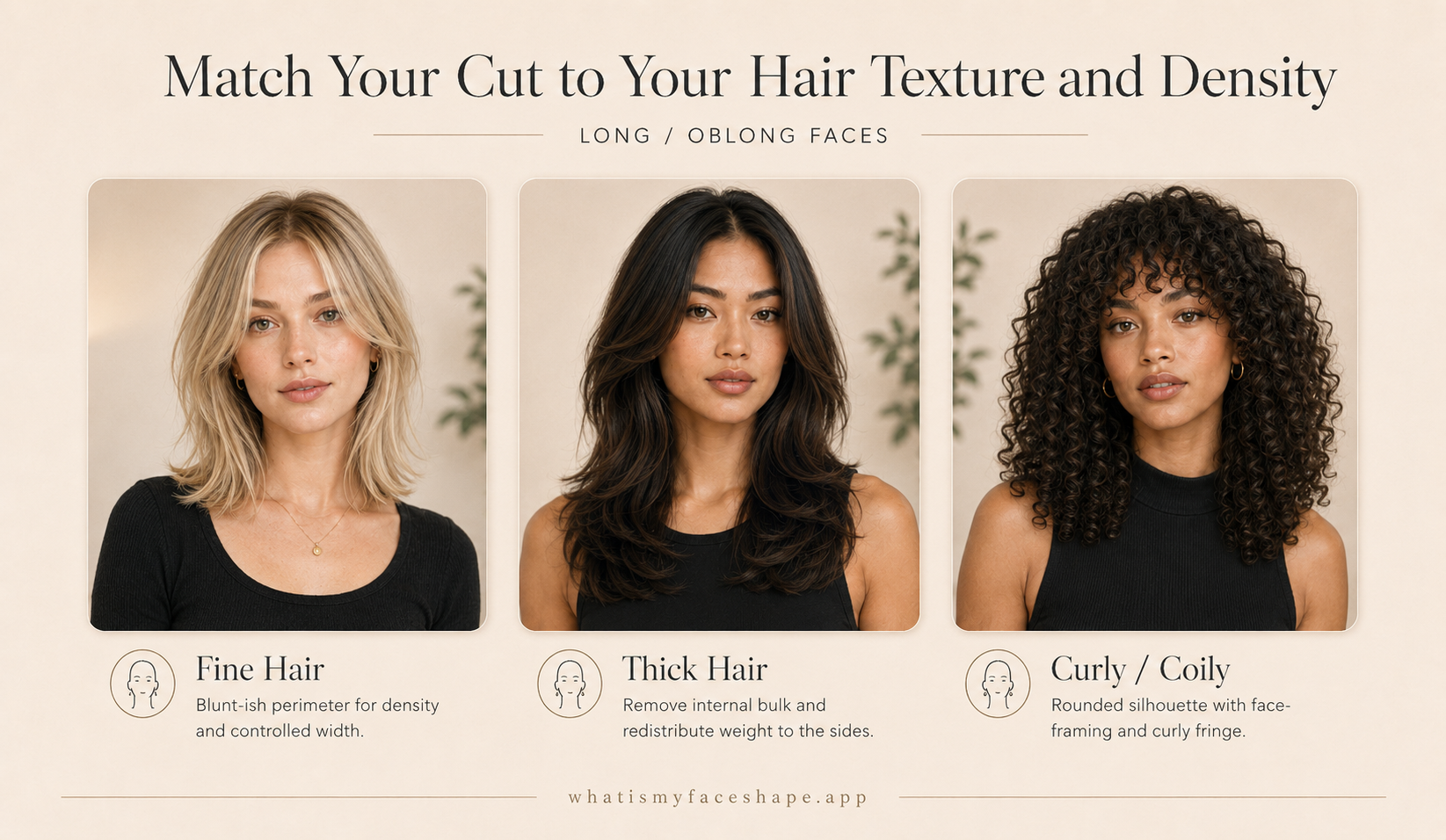
Fine hair
Fine hair plus a long face is a special kind of rude combination, because the hair tends to collapse and the face tends to read longer. The fix is not “remove weight.” The fix is shape: a blunt-ish perimeter for density, then strategic layers for movement, then styling that creates controlled width.
If you want more ideas around making narrow features look balanced, this thin and narrow face haircut guide is one of the rare pages that keeps it practical.
Thick hair
Thick hair can handle heavier bangs and stronger shapes, but thick hair can also create too much length if the cut becomes a heavy, vertical sheet. Internal debulking (without shredding the ends) matters, and so does where your volume lives. If your thick hair balloons at the crown, ask your stylist to redistribute the weight toward the sides.
Curly and coily hair
Curly hair is already doing the horizontal thing naturally, which is great for long faces, but only if the cut is shaped. A one-length curly cut can form a long triangle, depending on density and shrinkage.
For curls, ask for a rounded silhouette with face-framing that starts around cheekbone level, and consider a curly fringe or longer curtain bang. Coily hair can look incredible with a bang because it creates that forehead interruption without needing heat styling every morning.
Bring this salon request checklist
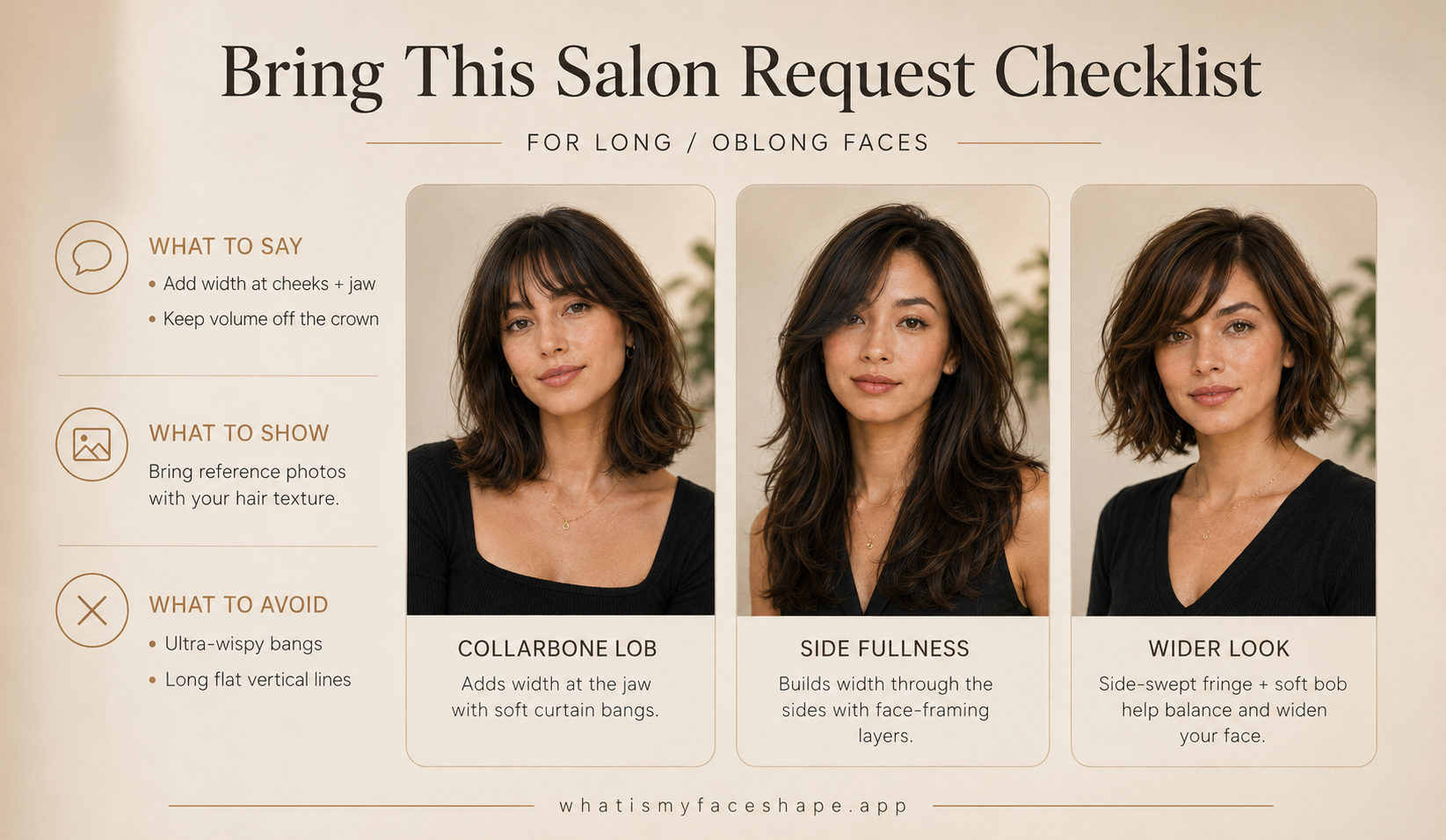
What to say
You’ll get a better result if you describe the visual goal, not just the haircut name. Try this, then shut up and let the stylist do their job:
- “I want to add width around my cheeks and jaw and reduce how long my face reads.”
- “I’m open to bangs, but I want them dense enough to look intentional.”
- “Please keep volume off the crown and build fullness through the sides.”
- “Let’s choose a part that makes my face look wider, even on lazy styling days.”
What to show
Bring photos of people with your hair texture, not just your dream vibe. Show front, side, and three-quarter angles if you can. And show at least one “realistic day” photo, not just a fresh-salon blowout, because your maintenance tolerance matters more than your Pinterest board.
What to avoid
Don’t ask for the haircut that only works with constant heat styling if you hate styling. Also avoid these common traps:
- Extra-long, pin-straight hair with no fringe and no face framing
- Crown height that makes your head look taller
- Ultra-wispy bangs that disappear into separation
- Layers that start too low and create vertical lines down the front
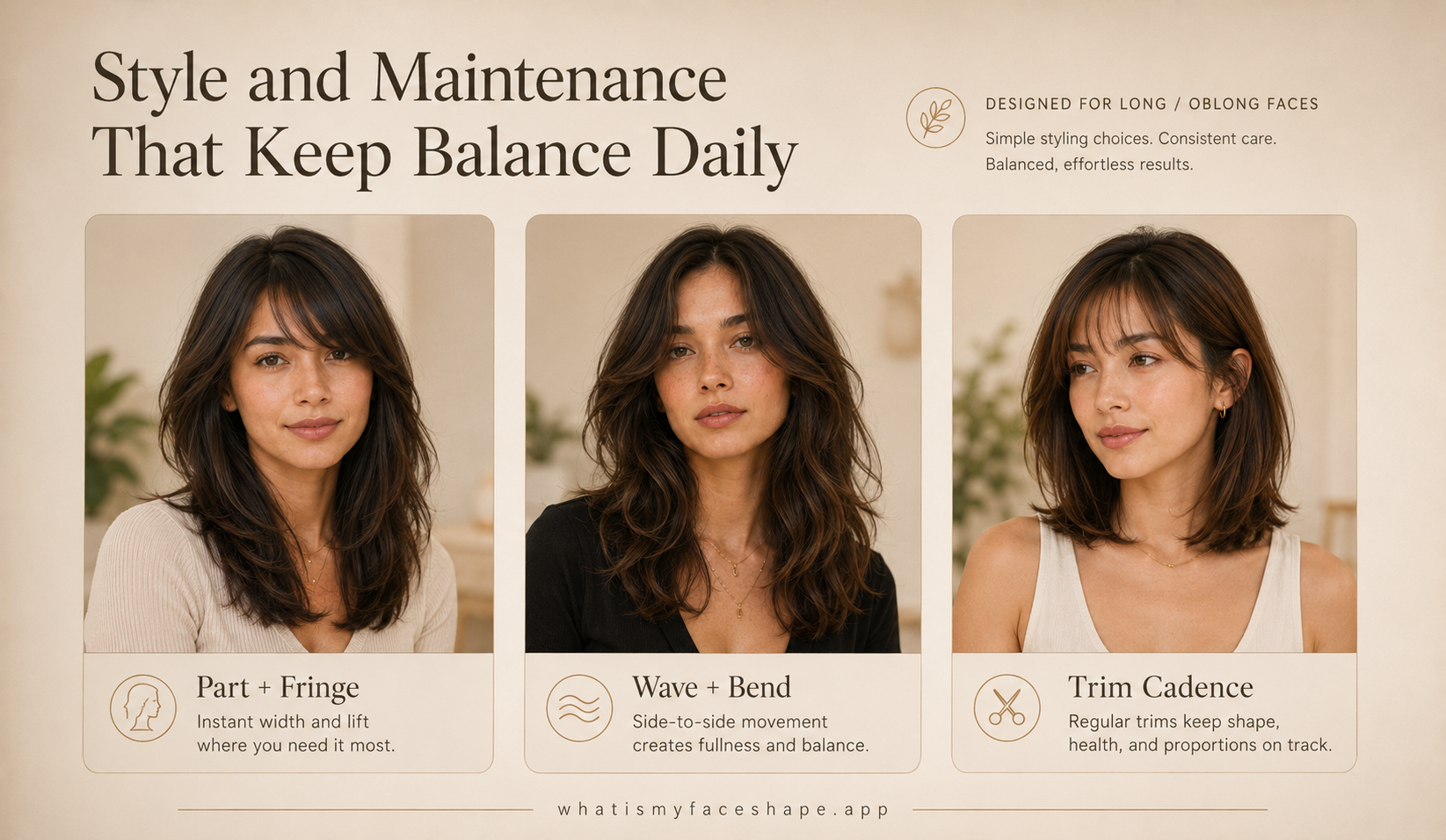
Style and maintenance that keep balance daily
Part and fringe styling
A side part can add instant width because it breaks symmetry and creates lift where you need it, but you can still wear a middle part if you build bend into the front pieces. For bangs, the trick is setting them while they cool. A quick blow-dry with tension, then a few seconds pinned or rolled forward, makes them behave.
Wave and bend tools
If you want the “shorter face” illusion without changing your cut every two months, you need side-to-side movement. A flat iron bend, a 1 to 1.25 inch curling wand, or a round brush blowout all work.
Tool quality matters more than people admit. Consistent heat distribution makes a difference when you’re trying to get a soft curve through the mid-length, which is part of why brands harp on ceramic tech like this thermal tool overview.
And since nobody talks about it until your wrist is on fire, use your forearm more than your wrist when you blow-dry. Salon ergonomics people have been begging us to stop wrecking our joints for years, and the point is laid out pretty plainly in this stylist ergonomics guide.
Trim cadence
Bangs usually need a trim every 3 to 6 weeks if you want them to keep doing their job. Bobs and lobs stay crisp with trims around 6 to 10 weeks, depending on growth and how sharp the perimeter is. Long layers can go longer, but if your ends thin out, the whole “add width” strategy collapses.
What if you want to keep your length?
Keep it, but stop treating “length” like the style. Length is just… measurement.
If you want long hair with a long face, you need a plan: fringe (or at least face framing), layers that create width around the cheekbones, and styling that adds bend through the sides. Loose curls, big brushed-out waves, even a subtle flip at the ends can do more for balance than chopping off 6 inches and leaving everything straight.
Also, be careful with super-dark, one-tone color on very long, very straight hair. It can read like a single vertical slab. Dimension helps, even if it’s just a soft balayage around the front.
What if you wear glasses or have a high forehead?
Glasses add their own horizontal line across your face, which can actually help a long face shape, as long as your hair doesn’t fight it.
If you wear glasses, ask for bangs that either sit cleanly above the frames (blunt or lightly textured) or sweep to the side so they don’t constantly collide with your lenses. Curtain bangs can work, but keep the shortest pieces high enough that they don’t poke the top rim all day.
If your forehead is high, blunt bangs are the strongest move, period, because they shorten the upper third immediately. If blunt feels too heavy, do a thicker curtain fringe that starts closer to the brow and opens at the center, rather than a long curtain that begins at the cheek.
Frequently Asked Questions
What are the most flattering haircuts for an oblong face female? Chin-length bobs, collarbone lobs with face-framing layers, and longer cuts with curtain or blunt bangs tend to be the most reliably flattering because they add width and interrupt vertical length.
Are bangs always a good idea for a long face? Usually, yes, because they shorten the face visually. The only time bangs backfire is when they’re too wispy to create a real horizontal line or when the styling requirement doesn’t match your life.
What should I avoid if I have a long face and fine hair? Avoid long, flat, center-parted styles with no fringe and no structure. Fine hair can look even narrower when it hangs straight, so you want shape, density at the ends, and movement through the sides.
Is a middle part bad for a long face? Not automatically. It’s bad when it creates two long vertical panels with no bend or face framing. If you keep a middle part, make sure your front pieces curve outward around the cheekbones.
Conclusion
Long faces don’t need “fixing.” They need smarter lines. If you remember one thing, make it this: create width at the cheeks and jaw, break up the forehead with a bang, and stop piling height on top like you’re trying to win a prize for tallest silhouette. Your haircut should make your features feel balanced on a random Tuesday, not just in the salon chair.