Introduction
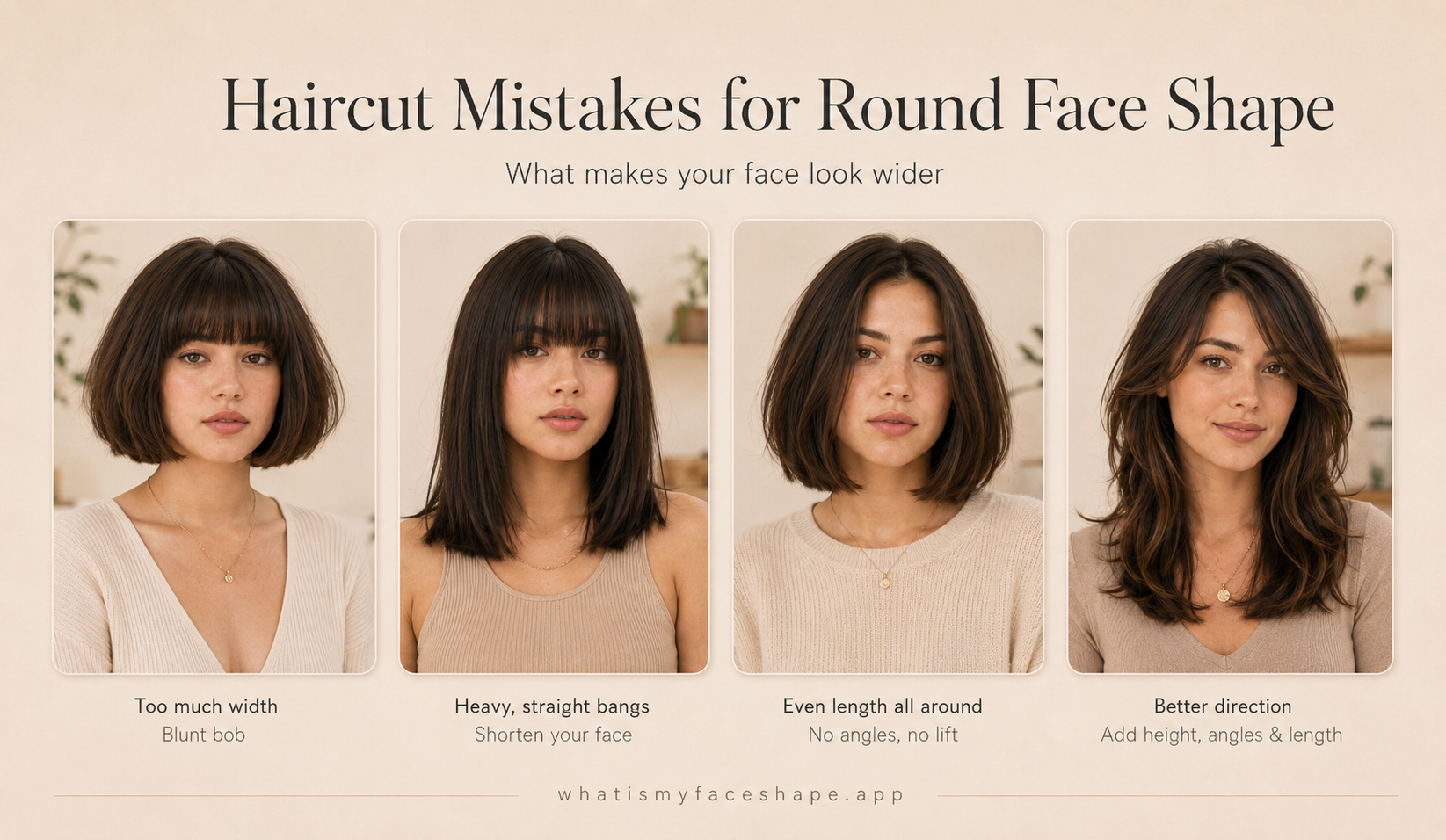
If your haircut keeps making your round face shape look wider, it’s almost always the same handful of issues: too much horizontal weight at the cheeks or jaw, not enough height at the crown, and “perfectly even” lines (parts, bobs, bangs) that turn soft facial features into a literal circle in the mirror. The fix is boring but powerful. Build vertical height, add angles, and keep bulk off the cheek line.
And yes, the emotions around this are weirdly intense. A lot of people feel blindsided by a “fine” haircut that suddenly reads as puffy or childish in photos. You are not being dramatic. Surveys about haircut regret are genuinely bleak, like the one noting how many people have straight-up cried after a cut that didn’t match the image in their head, which is why I keep a tab open on this whole psychology-of-regret rabbit hole when I’m tempted to do something impulsive with my own hair, like this breakdown of the expectation gap behind haircut regret.
How do you confirm a round face?
Quick mirror checks
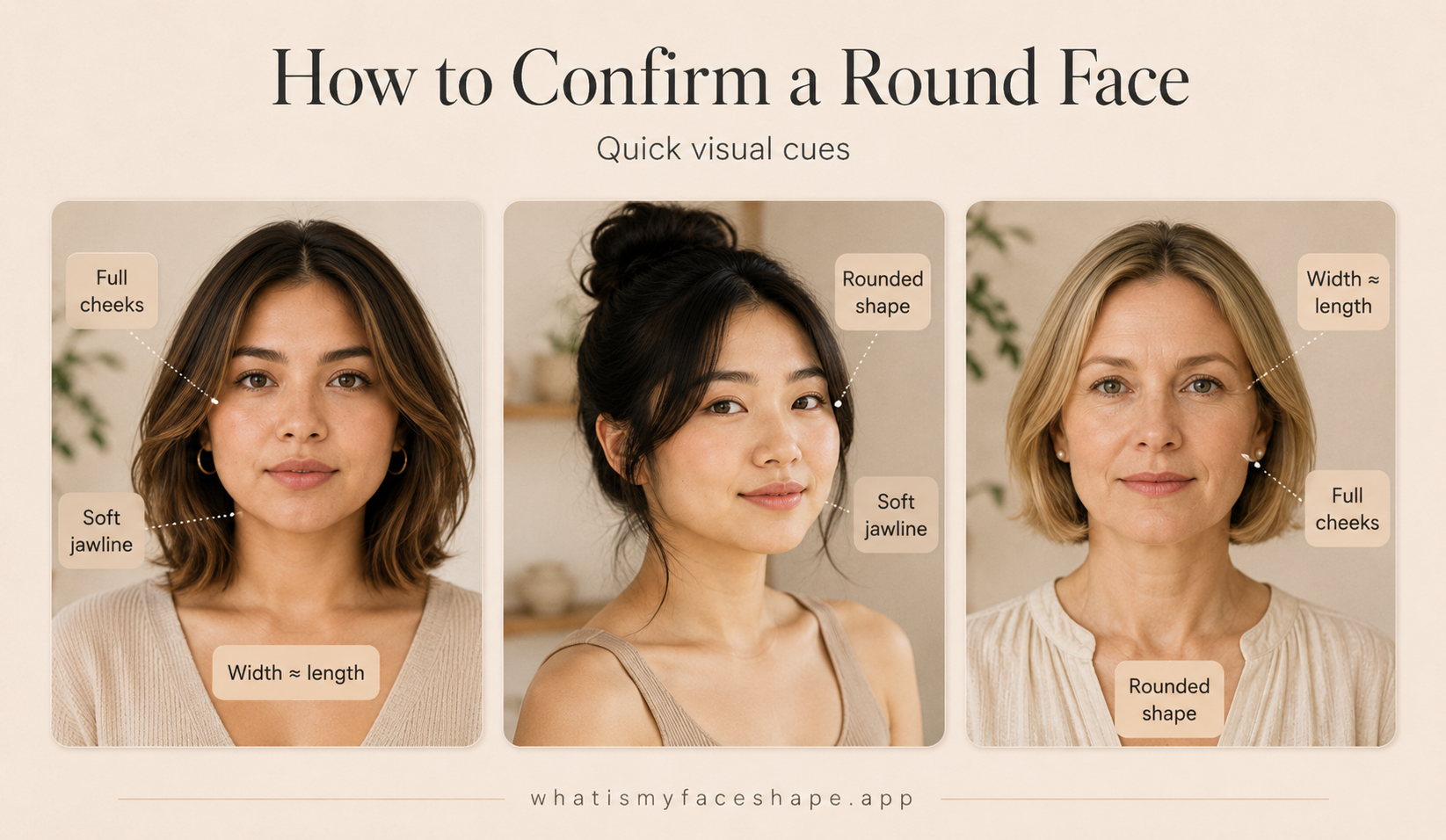
Most people mis-ID their face shape because they stare at one feature, usually cheeks, and ignore proportions. The round face pattern is simple: length and width read close to equal, cheekbones look like the widest point, and the jawline is curved instead of pointy. The forehead and jaw feel similar in width, and the chin tends to be short, not long.
You don’t need to be forensic about it. You just need to know whether your cut is fighting your proportions or working with them.
Photo and measurement test
Photos flatten depth and exaggerate width, which is exactly why round faces feel “wider” after the wrong cut. Use that to your advantage.
Take a straight-on photo (not a selfie with a wide lens, please), hair pulled back, neutral expression. Then do the quick comparison below.
| Check | What you’re looking for | What it suggests |
|---|---|---|
| Cheekbone width vs jaw width | Similar, with a soft curve | Roundness dominates the frame |
| Length (hairline to chin) vs width (cheek to cheek) | Close to 1:1 | Classic round face proportions |
| Jaw definition | Rounded jawline, no sharp angle | Needs angles created by cut and styling |
If the numbers are close, you’re in the round face shape neighborhood. You can still have a strong chin or a higher forehead and be “round.” People aren’t emojis.
Common lookalikes
The big confusion is oval vs round. Oval has more vertical length and usually a slightly narrower jaw. Heart shapes get misread too because cheeks can be full, but the chin is more pointed and the forehead is wider.
Also, weight changes everything visually. Same skull, different softness. So if you’re thinking “my face used to be oval,” you might not be wrong. Your haircut just needs to handle today’s proportions, not your high school yearbook.
What makes a style widen your face?
It’s optics. You’re basically designing lines around a curved canvas. When you add width at the wrong altitude, the whole look gets squat.
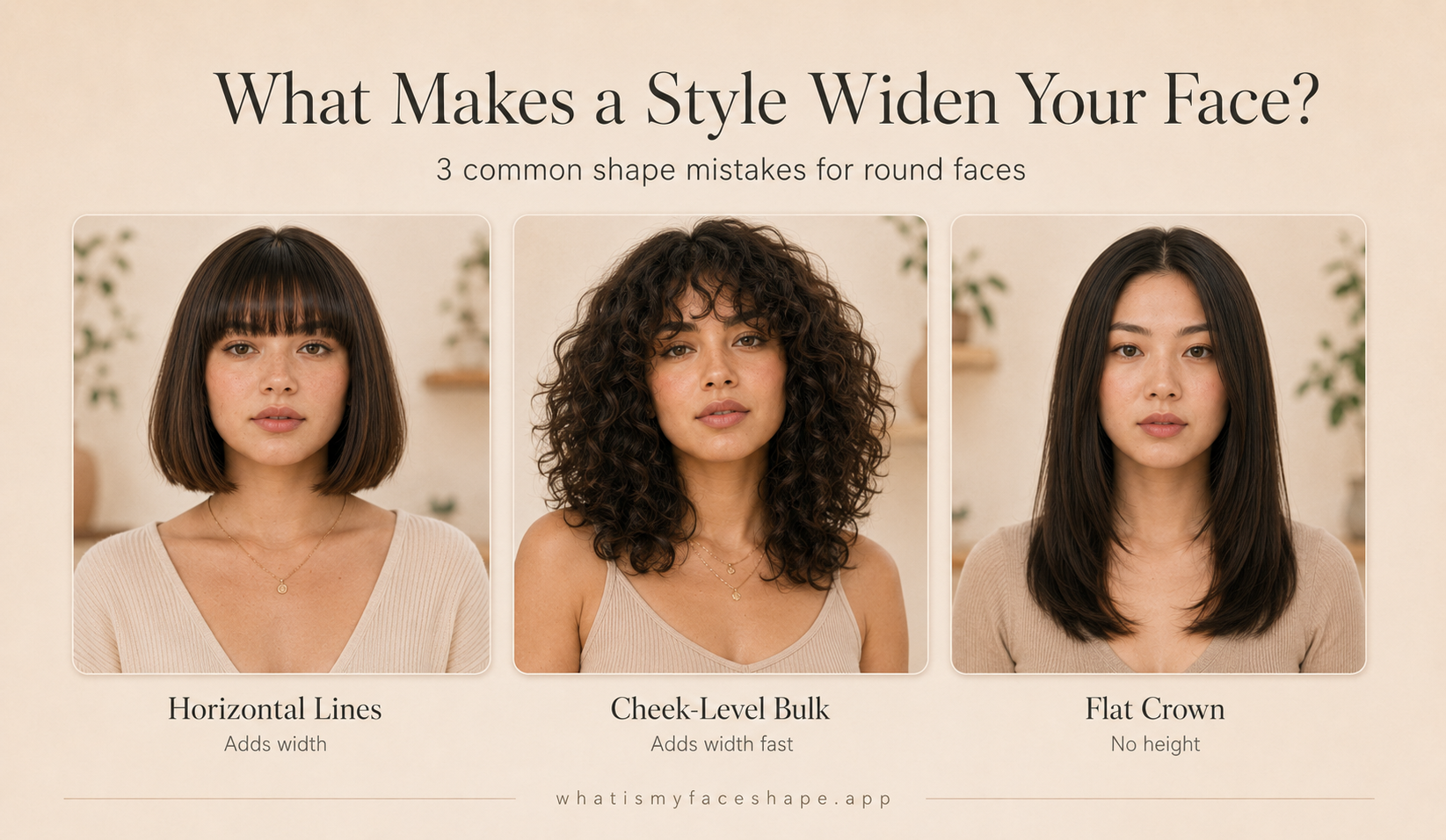
Here are the three mechanics that cause most “why do I look wider” panic:
- Horizontal lines that land at the widest part of the face, usually the cheekbones or jawline.
- Cheek-level bulk from curls, layers that start too high, or blunt density sitting on the sides.
- Flat crown that removes vertical height, so the eye travels left-to-right instead of up-and-down.
Horizontal lines
A blunt perimeter is a line. A straight fringe is a line. A dead-center part is basically two lines that frame width perfectly. Round faces don’t need more “even.” They need a little disruption. Angles. Direction. A bit of asymmetry.
Cheek-level bulk
Volume is not the enemy. Placement is. When the fullest point of your hair matches the fullest point of your cheeks, the silhouette gets wide fast. This is why a lot of cute cuts look adorable on the salon floor and then feel off the moment you see yourself in daylight.
Flat crown
No height at the top equals instant “moon.” Harsh, but accurate. A round face reads best when the crown has lift, even subtle lift, because it stretches the visual line of the head and gives the eye somewhere to travel besides outward.
Avoid these cut and bang choices
Blunt chin bob
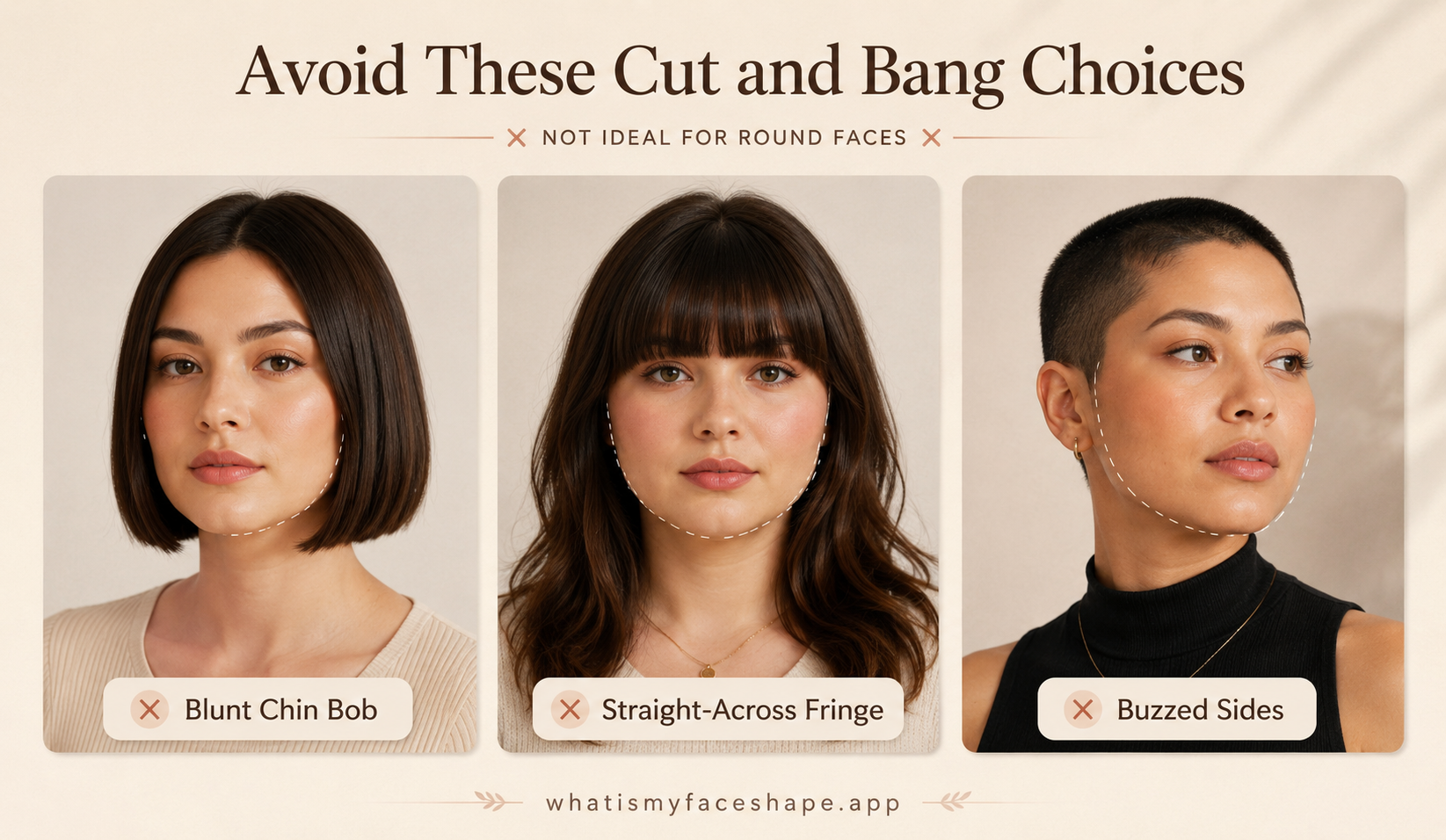
This is the classic trap. The one-length bob that hits right at the jawline creates a strong horizontal line exactly where many round faces are widest. Celebrity stylists have been saying this for years, and you’ll see it echoed in mainstream guidance like this round-face haircut advice from L’Oréal Paris, because it’s not a trend issue, it’s geometry.
If you love short, you can still do a bob. Just don’t park the perimeter right on the jaw with zero graduation.
Straight-across fringe
Thick, blunt bangs cut the vertical space of your forehead and make the face look shorter overall. That’s the opposite of what most round faces want. A fringe can be great, but it has to “behave,” meaning it should create direction and softness, not a hard shelf.
If you want the simplest rule: avoid bangs that look like they were cut with a ruler and styled with a grudge.
Buzzed sides
Super short sides with no height on top can make the head look rounder because you’ve removed your ability to create structure. This shows up in extreme fades, tight crops, and some buzz cuts, especially if your hairline is soft and your jawline is rounded.
I also think people underestimate how much they rely on side hair to visually “carve” cheekbones. Take it away, and the face gets louder.
Avoid these part and texture choices
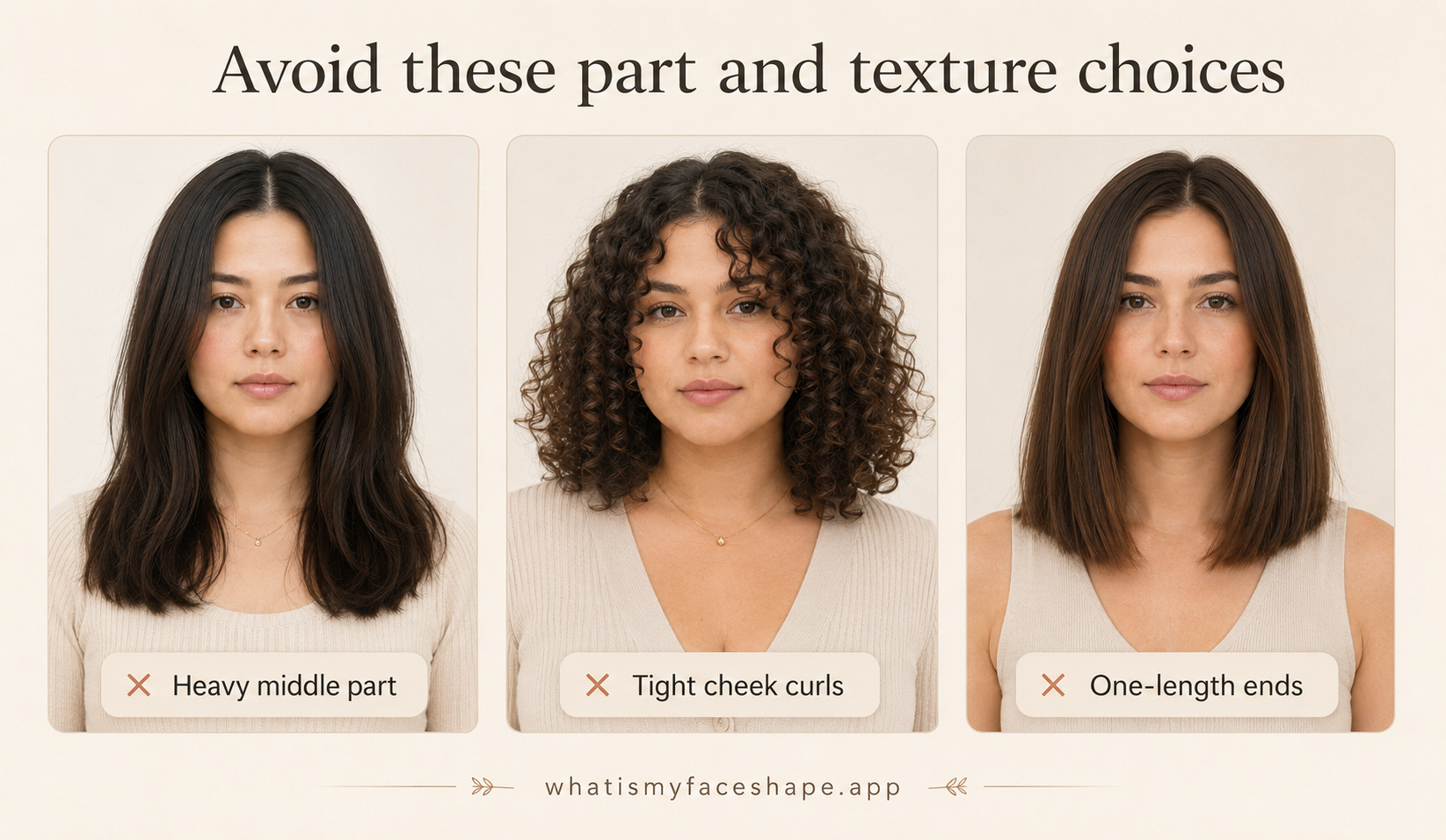
Heavy middle part
A dead-center part can highlight width because it splits the face symmetrically and tends to collapse crown lift. A stylist quoted in coverage like this Wales Online piece on best and worst cuts by face shape basically lands on the same point: round faces usually do better with imbalance.
Not everyone needs a dramatic side part. You just need a part that doesn’t turn your hair into curtains that stop at your cheek line like parentheses.
Tight cheek curls
Curly and wavy hair is not a problem. The problem is when you build a perfect orb of curls right at cheek level. Diffuser volume that blooms outward at the sides can widen the silhouette, especially if the cut is one-length.
If you wear curls, you want your biggest volume either higher (crown) or lower (past the chin), not centered on the cheeks.
One-length ends
One-length ends create a heavy perimeter. On a round face, that perimeter can read like a frame around the widest points. Even if your hair is long, blunt ends plus no face-framing can make the whole look feel blocky in photos.
I like movement. A little bevel. A little texture at the ends. Anything that prevents the outline from becoming a single unbroken line.
Choose cuts that add height and angles
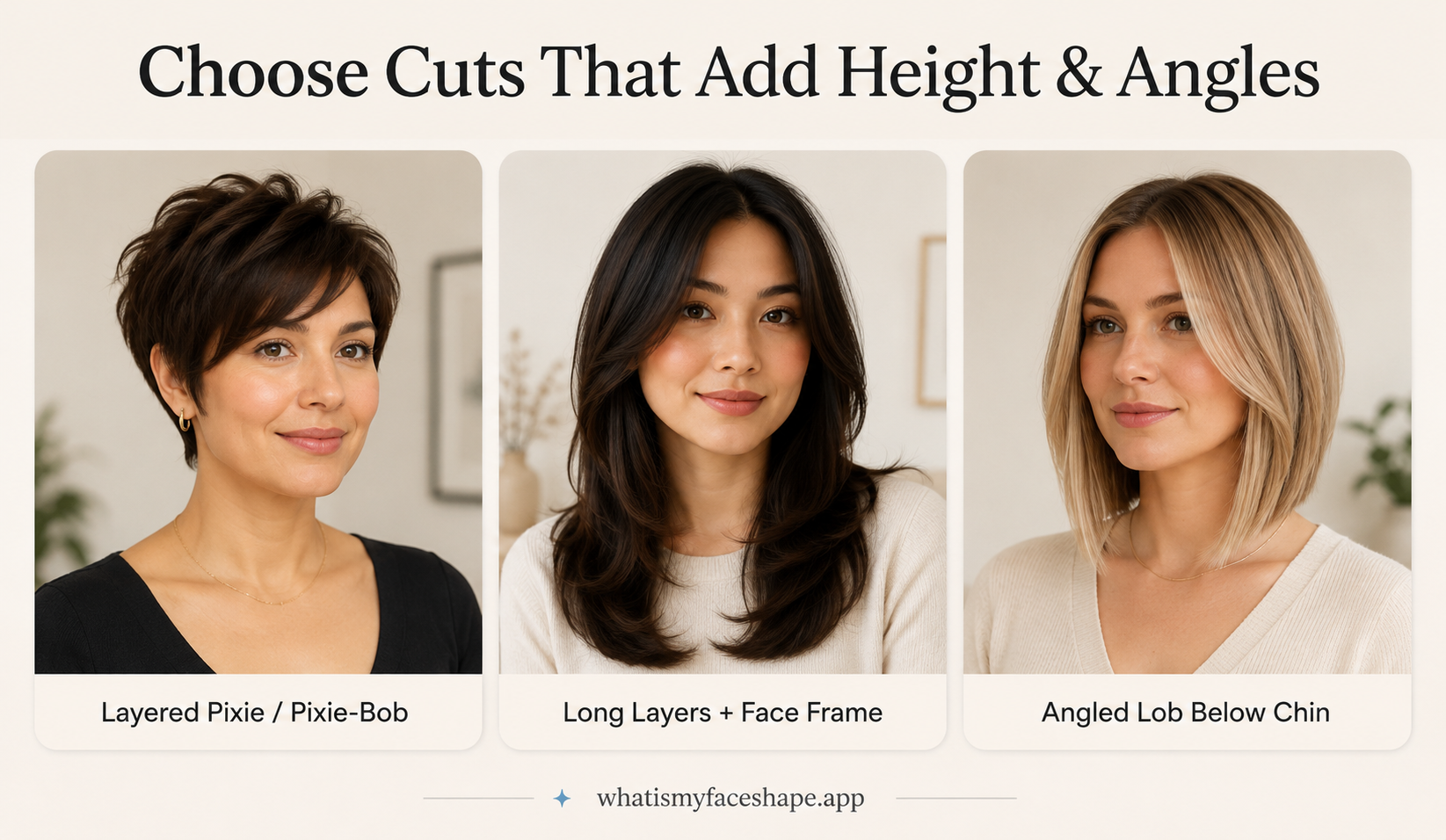
This is the part where people think they need “long hair” to look elongated, and honestly, no. Short can be fantastic if it’s built with intention. The winning move is height at the crown and soft face framing, not a bowl-y shape that widens at the cheeks. I’m annoyingly firm about this.
Layered pixie and pixie-bob
If I were choosing for a round face that feels “too chubby” lately, I’d go short only if I could keep lift up top and texture through the crown. A layered pixie or pixie-bob does that well, especially if you’re willing to style it instead of air-drying and hoping for mercy. Even mainstream inspo pages that skew consumer-friendly get this right, like this quick guide to short hair options for round faces.
This is also where a good stylist will talk about head shape, not just face shape. Occipital bone matters. Crown swirl matters. Density matters. The cut is architecture.
Long layers with face frame
Long layers can slim a round face when the face-framing starts past the chin, not at the cheeks. That “start past the chin” guideline is repeated by pro outlets for a reason, including this StyleCaster take on layers for round faces. If your first layer hits the cheekbone, you just built a shelf for width.
If you’re someone who wants bangs but fears commitment, curtain bangs paired with a layered cut are basically insurance, and I’ve seen the same recommendation show up in places like this Fabbon roundup for chubby/round faces because it’s a repeatable win.
Angled lob below chin
An angled lob that lands below the chin (collarbone-ish, depending on your neck length) creates a diagonal line instead of a straight one. Diagonals are your friend. A-line shapes are your friend. Anything that points downward instead of outward.
This is also a great compromise cut for people who want shorter hair but aren’t ready to lose ponytail options.
Style for length, not width
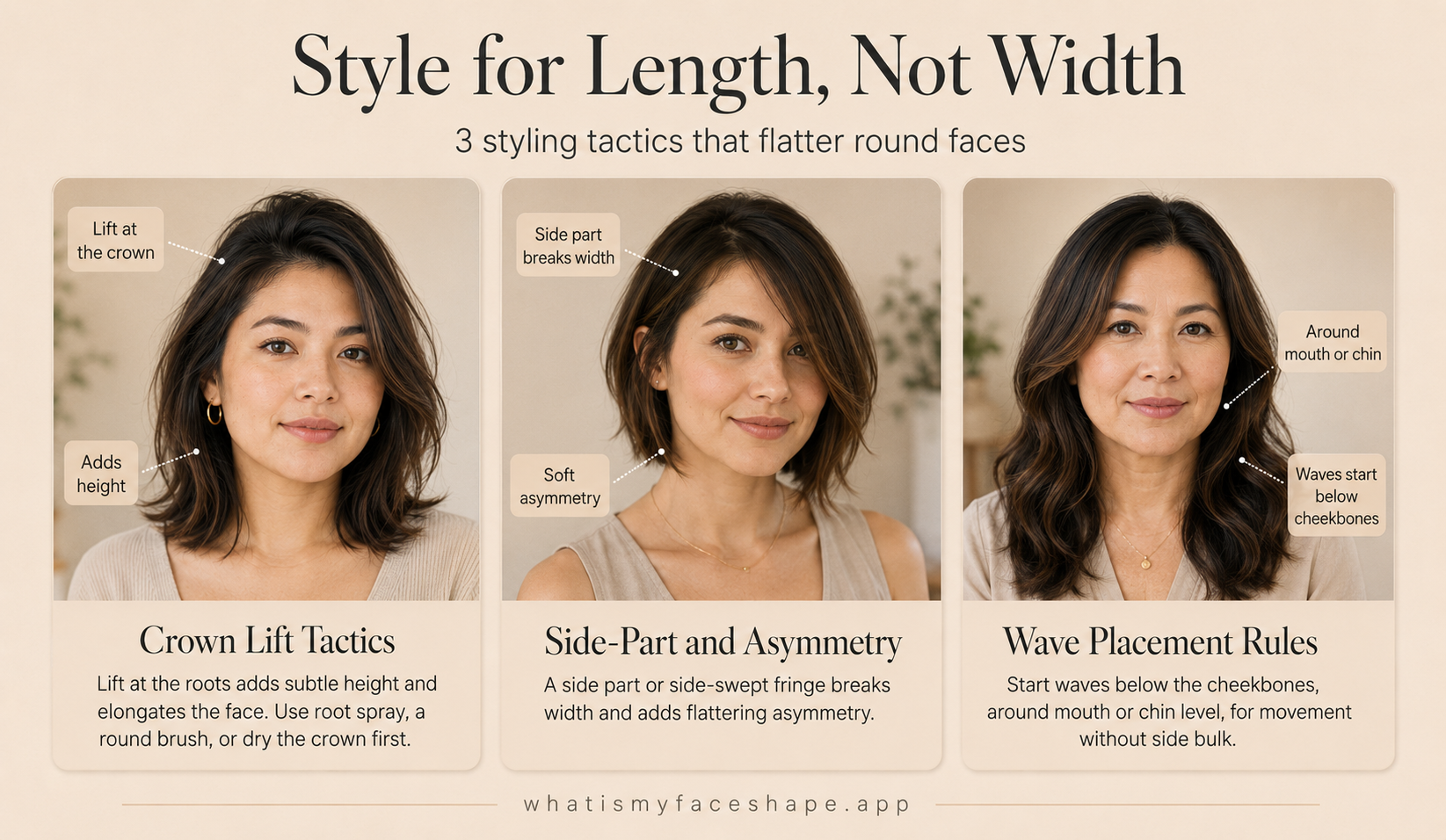
A cut can be technically correct and still fail because styling is where roundness gets amplified. The salon blowout lies to people. It’s not malicious. It’s just… optimized for the chair, not your real life.
Crown lift tactics
Crown lift is the cheat code. It doesn’t have to be 4 inches of teasing. You can get subtle height with root spray, a round brush, or even flipping your part while it cools. If you have fine hair, use mousse at the roots and blow-dry the crown first. If you have thick hair, rough-dry the roots upward before you start smoothing anything.
One small note from Los Angeles life: humidity is not your enemy the way it is in, say, Singapore or Miami, but heat damage is. So if you’re chasing lift with a hot tool every day, use heat protectant and stop frying your ends into one-length straw.
Side-part and asymmetry
A side part creates asymmetry, and asymmetry breaks up width. It also helps if you wear a fringe, because a side-swept bang creates a diagonal across the forehead instead of a straight line.
If you want inspiration that leans trendy, not rigid, the photo-heavy examples at LoveHairstyles for short round-face cuts show how much a little imbalance changes the vibe.
Wave placement rules
If you wear waves, keep the wave pattern starting lower than your cheekbones. This matters for every hair type: straight hair with a curling iron, natural wave, heatless waves, all of it. Start the bend around the mouth or chin, leave the roots smoother, and you’ll get movement without side bulk.
If you’re curly, ask for curl-by-curl shaping that removes weight at cheek level but keeps enough length to drop the curl past the widest point of the face. Shrinkage is real. Plan for it.
Pair hair with makeup and accessories
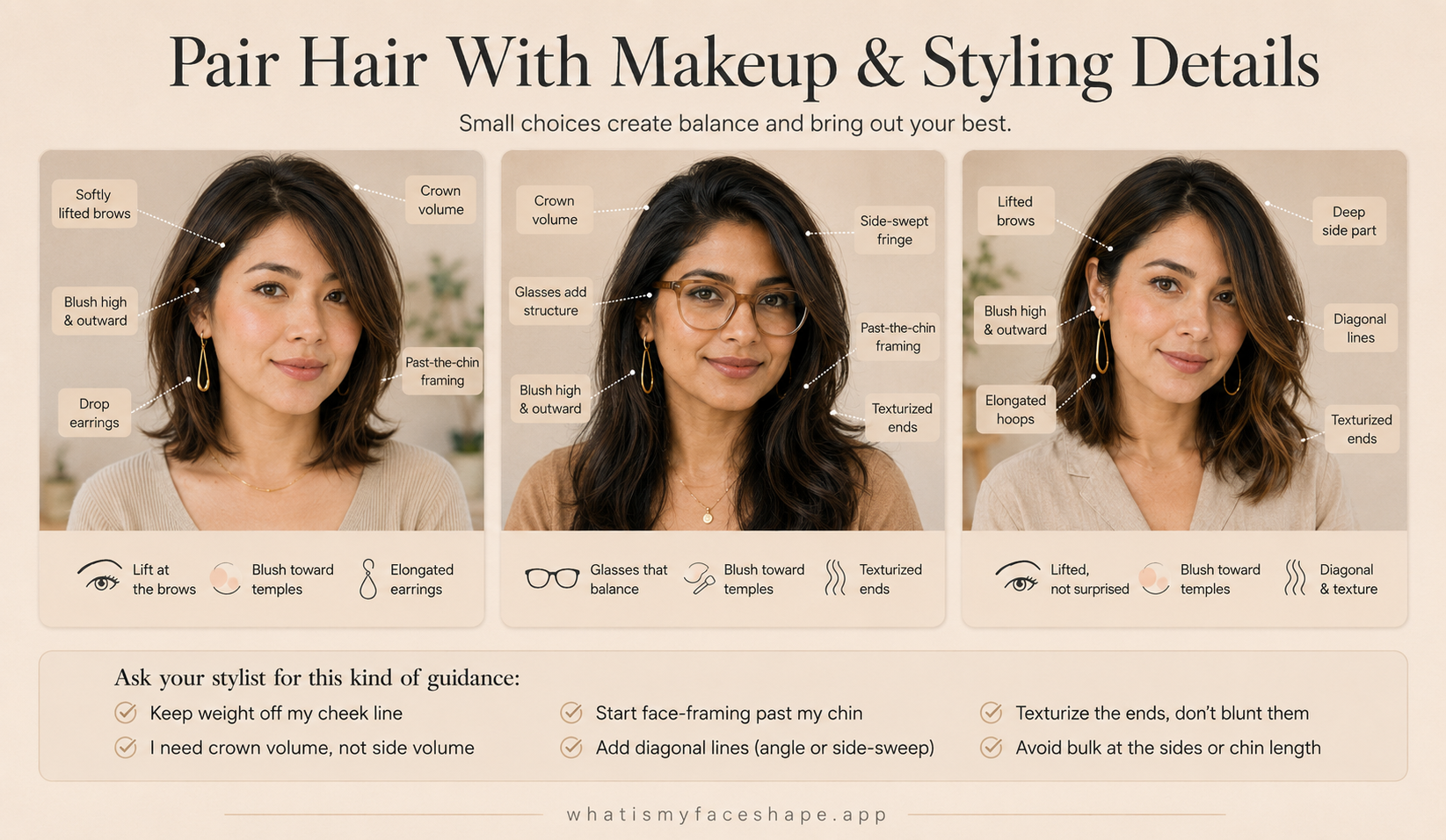
Hair doesn’t exist alone. Earrings change proportions. Glasses change proportions. Even where you place blush can make a round face read wider or more sculpted.
If you want quick, practical pairings: keep brows slightly lifted (not surprised, lifted), use blush a bit higher and outward toward the temples instead of centered on the apples, and consider earrings that pull the eye down, like drops or elongated hoops, rather than big circles that echo the roundness.
Necklines matter too. Crew neck plus chin bob plus blunt bangs is the kind of stacking mistake that makes people hate their reflection for no good reason.
Ask your stylist for these specifics
Most haircut mistakes happen in the consult, not during the cutting. Salons are busy, consults get rushed, and you walk out with a trend instead of a plan. There’s also industry pressure that shortens appointment time, which is why I like being overly specific rather than hoping your stylist reads your mind.
When you sit down, ask for this kind of language:
- “Keep weight off my cheek line” and show where your cheekbones sit when you smile.
- “I need crown volume, not side volume” so they build height and avoid a flat top.
- “Start face-framing past my chin” to avoid widening layers.
- “Add diagonal lines” with an angle, side-swept fringe, or an A-line perimeter.
- “Texturize the ends, don’t blunt them” if one-length makes your face look broader.
If your stylist pushes back because “face shape is overrated,” I get it, some of that discourse is a reaction to rigid rules, and honestly it’s refreshing. Even so, when a cut makes you feel wider, it’s not because you’re imagining things. It’s because lines and volume placement are doing what they do.
If you want a smart quote to keep in mind, creative directors interviewed in fashion outlets often say the same basic principle: create interest and angles to elongate, like in this Vogue guide to flattering cuts for round faces. That’s the whole game.
Frequently Asked Questions
How do I know if my haircut is widening my face or if I’m just overthinking it? If the widest point of your hair silhouette sits at your cheeks or jaw, and your crown is flat, the cut is likely widening the frame. Check a straight-on photo. The camera is brutally honest.
Are bangs always bad for a round face? No. Heavy straight bangs are the common mistake. Curtain bangs, longer side-swept fringe, and textured bangs can add angles and break up symmetry.
Can a round face pull off a bob? Yes, as long as the bob is angled or longer than the chin, with movement and some crown lift. The classic blunt chin bob is the one that tends to go wrong.
What if I love a middle part? Keep it, but cheat it. Add root lift at the crown, tuck one side, or build asymmetry with your cut. A middle part plus flat crown plus cheek bulk is the combo that backfires.
Does hair length matter more than the haircut shape? Shape matters more. Long, one-length, blunt hair can widen a round face. Short hair with height and soft framing can elongate it.
Conclusion
Round face shapes don’t need to be “fixed.” They need smarter lines. When a cut makes you feel wider, it’s usually because it stacked horizontal choices: blunt perimeter at the jaw, even part, heavy fringe, bulk at the cheeks, flat crown. Reverse those, and the same face suddenly looks more balanced, more defined, more like you expected to look when you booked the appointment in the first place.
If you’re tempted to do a big chop, do it, but do it with shape-thinking. Height up top. Angles through the outline. Soft framing where it counts. The rest is just noise in the salon mirror.