Compare your observations
Look at facial length, forehead, cheekbones and jaw as separate observations. Use measurements as notes rather than a beauty score.
Explore face shapes ↗Begin with what you can see in one steady view. A shape word can wait until your notes make sense to you.
Choose consistent landmarks
Look across your forehead, cheekbone area, and lower jaw, then notice the overall length of your face. Keep your hair clear of the outline if it helps you see it. Zenni Optical’s face shape guide describes a heart outline with a wider forehead and narrower chin. That description gives you a useful upper-to-lower comparison; it does not require measuring your bones or meeting a numerical cutoff.

Write down each observation in ordinary words. “My cheekbone area looks wider than my forehead” is more useful than jumping straight to a category. Zenni uses wider cheekbones, with a narrower forehead and jawline, in its diamond description. Treat that as a verbal comparison, not a measured range. For a simple way to begin, Start observing with the site’s checklist.
Record rather than rank
If you choose to note lengths, use the same unit and write down what you compared. A note such as “length appears greater than width” can be enough. Zenni describes an oval outline as longer than it is wide, with softer contours; it gives no ratio that you need to reach. Your notes are a record of what you noticed, not a score or a calculation of attractiveness.

Keep photo conditions in mind before comparing numbers from selfies. A published camera-distance model by Ward and colleagues shows that a shorter camera distance can change the apparent breadth of the nose relative to the distance between the cheekbones. It does not provide a correction for every face measurement. Numbers from two differently framed selfies should not be treated as direct measurements of your face.
Interpret the notes cautiously
Return to the individual observations: what looks wider across the upper face, where the cheek area stands out, and how the jaw moves toward the chin. A note that the forehead seems wider than the lower face does not automatically produce a heart result. It is one part of an outline, and your view may change with the angle or hairstyle.
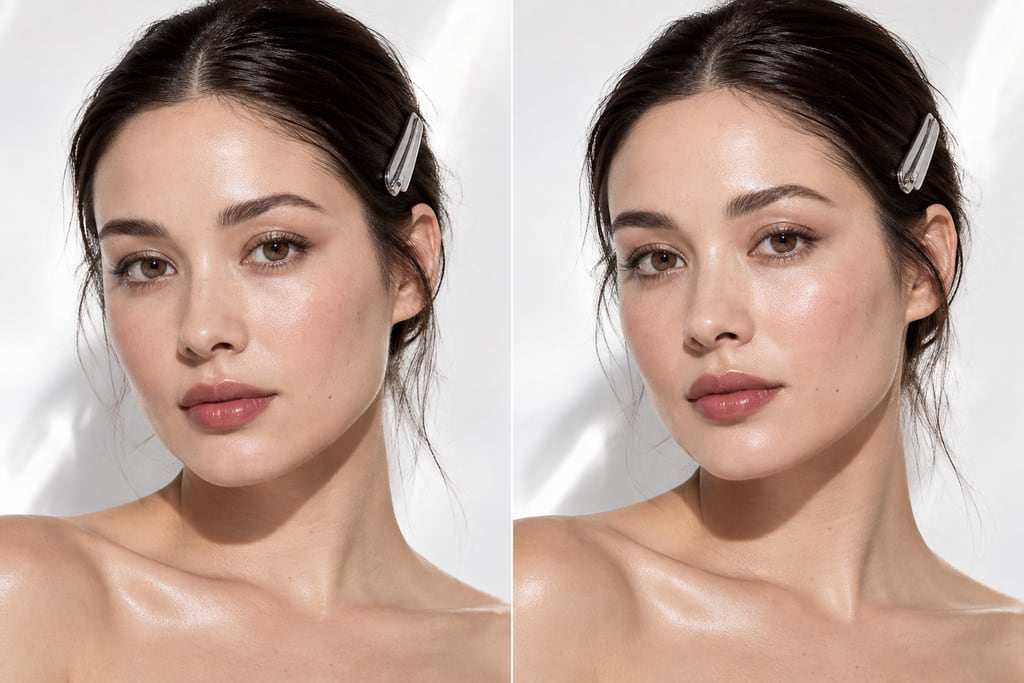
For a next comparison, Zenni’s heart description emphasizes a wider forehead and narrower chin, while its diamond description emphasizes cheekbones wider than the forehead and jawline. If your notes borrow from both, keep them both. You can Explore face shapes as a vocabulary for what you see, without forcing a final label.

Your next question
Does a ratio calculate my face shape?
No calculation here assigns a face shape. A description such as “longer than wide” can help you write an observation, but the cited oval description supplies no numerical threshold.
Can I compare measurements from different selfies?
Use caution. Camera distance can change apparent proportions in a photograph, as Ward and colleagues modeled for nose breadth relative to cheekbone distance. Photos taken at different distances are not interchangeable measurements.