A guide to oblong face shapes
Explore an oblong face description and note what you see in your own outline. Choose styling ideas around your preferences.
Explore face shapes ↗Begin with the outline you can see. Keep the words that help, and let your own taste guide the next step.
Describe the outline
Zenni Optical’s face shape guide describes an oblong face shape as a “long, narrow silhouette.” Think of that as an impression of the overall visible outline, from your forehead toward your jawline and chin. It is a set of descriptive words, not a ratio to calculate or a particular hairline you must have.

You might write, “My outline looks long and narrow,” or describe only the part that stands out to you. A face shape word does not need to account for every feature. If you want to look more deliberately, Start observing with a simple checklist that moves from forehead to chin.
Compare with oval

The nearby word “oval” can also describe a face that looks longer than it is wide. In Zenni’s face shape guide, the oval description emphasizes softly rounded contours, while its oblong entry emphasizes a long, narrow silhouette. You may recognize parts of both descriptions; there is no numerical dividing line on this page.
Oval description
Longer than wide, with softly rounded contours in Zenni’s guide.
Oblong description
A long, narrow silhouette in Zenni’s eyewear guide.
When comparing photos, notice how they were taken. A published camera-distance model by Ward and colleagues examines how a closer camera can change the apparent width of the nose relative to cheek-to-cheek width. It does not establish a face-length cutoff. If two photos look different, camera distance may be one reason to pause before treating either image as a precise outline measurement.
Explore face shapes ↗Explore your preferred silhouette
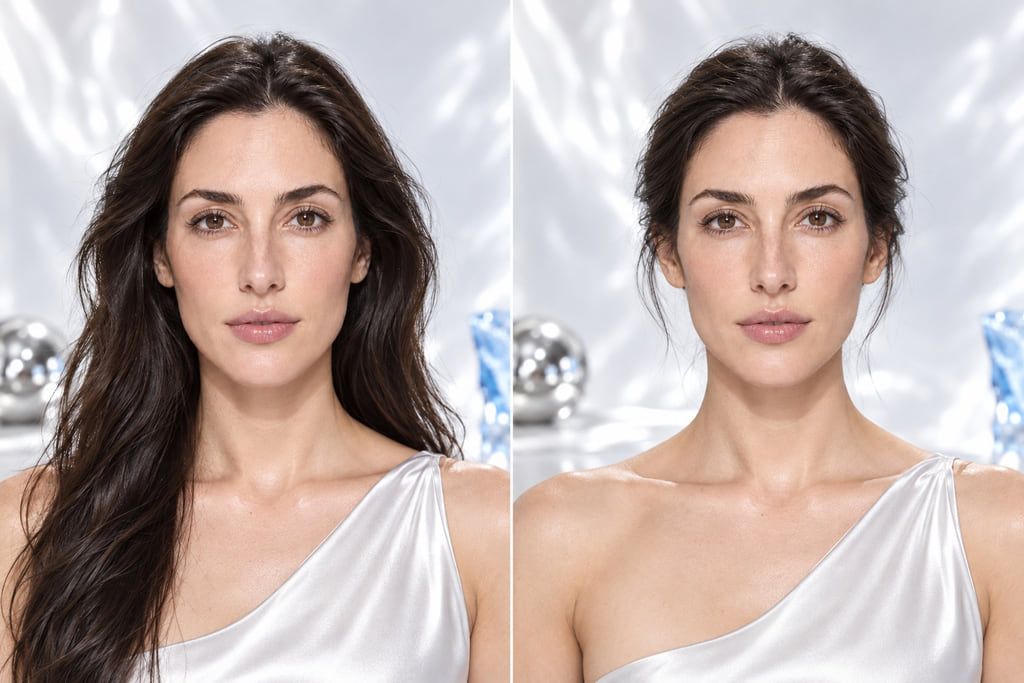
Now put the label aside for a moment. Would you like your hair to frame your cheeks, or would you rather keep it away from your face? Do you prefer glasses that feel quiet or more noticeable? Zenni presents shape-based frame suggestions as possibilities, leaving room for personal preference. Long hair is not off-limits because an outline seems oblong.

For an oblong face haircut, describe the effect you want rather than asking for a cut that “fixes” a proportion. The same goes for oblong face glasses: fit, comfort, and your preferred look can lead the conversation. Note one detail you want to try, then use the Style Notebook to turn that preference into your next question.
Your next question
Is there a numerical cutoff for oblong here?
No. The cited oblong description uses the words “long, narrow silhouette.” This guide does not add a ratio or a diagnostic test.
Must an oblong outline look shorter?
No. A shorter-looking outline is not a default goal. Styling suggestions are options; choose the hair, frames, and lines you enjoy wearing.